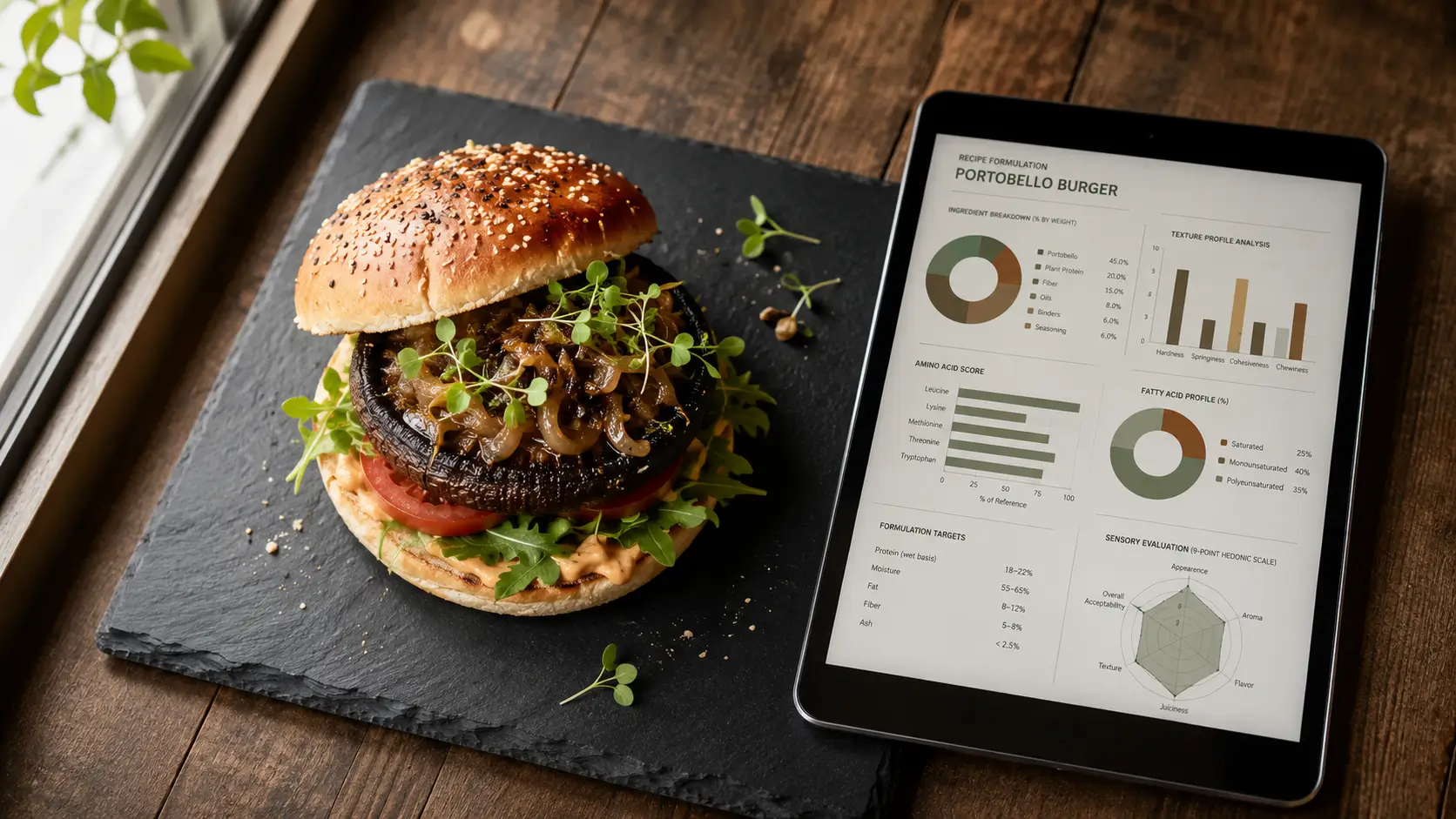
A generative model trained on more than 2,200 recipes just produced a mushroom burger with roughly one‑tenth the environmental impact of a Big Mac, and beat it on taste in a blind trial.
For most of the plant‑based industry, the honest problem has always been the same one.
Consumers say they want healthier, greener meat alternatives, and then they pick the burger that tastes better.
A new study out of Stanford tries to close that gap using generative AI, and the results are worth paying attention to.
Researchers from the Living Matter Lab, led by Professor Ellen Kuhl, trained a diffusion‑based model on 2,216 real burger recipes drawn from Food.com.
The system, nicknamed BurgerAI, then generated one million new formulations and screened them for taste, nutrition, and environmental impact.
The peer‑reviewed paper, published in npj Science of Food and previewed on arXiv, reports that the top AI‑designed recipes did something plant‑based burgers have rarely done in a real restaurant setting.
They won.
What The Study Actually Found
The team took a handful of AI‑generated recipes into a San Francisco restaurant and ran a blind sensory trial with 101 participants.
Two AI burgers optimized for taste matched or beat a Big Mac on flavor and overall liking, with comparable texture ratings, according to the Stanford Report writeup.
One of those top performers was a portobello mushroom burger with arugula, rosemary, grains, and condiments.
Its environmental impact score, calculated using global food emissions databases, came in more than an order of magnitude lower than the Big Mac reference.
A separate bean‑based burger, optimized for nutrition rather than pure palatability, reached a Healthy Eating Index score of 63.12, roughly double the Big Mac’s 33.71, with about one‑sixth of the environmental footprint. That one lost the taste test.
Tasters rated it lower on flavor and texture, which is the trade‑off the researchers had actually been trying to map.
That is the useful part of this paper. It is not a press release claiming AI has cracked the plant‑based code.
It is a paper showing that taste, nutrition, and sustainability sit in tension, and that a model can search that trade‑off space in a way a human food scientist cannot.
Why This Is Different From Every AI Recipe Story You’ve Seen
There is a small industry now of headlines about ChatGPT writing pasta recipes. This is not that.
BurgerAI is a diffusion model, the same class of architecture behind image generators like Stable Diffusion.
Instead of picking pixels, it picks ingredient combinations and quantities.
The team mapped 146 unique ingredients into families: proteins, produce, herbs and spices, grains, sauces, dairy, nuts and seeds.
That library defines the design space the model draws from.
So when the researchers say the model generated a million recipes, they mean a million real formulations with real quantities, screened programmatically before any human ever tasted one.
That is closer to how pharma companies screen molecules than how a food blogger uses AI.
The Stanford team frames the burger as a test case.
Kuhl told her own university’s press office that food is a good proving ground because it has a large, human‑scale design space, measurable outcomes for nutrition and emissions, and real taste feedback.
The bigger claim, laid out in a companion paper, is that the same approach could apply to drug discovery and materials science.
For our purposes, though, the burger is the interesting bit.
The Trade‑Off Nobody Wants To Talk About
Here is what the paper quietly makes clear. The healthiest burger did not win the taste test.
The bean‑based formulation scored roughly twice as high as the Big Mac on the Healthy Eating Index.
It came out ahead on vegetables, whole grains, and plant protein, and lower on refined grains, sodium, and saturated fat.
In the blind tasting, participants preferred the Big Mac.
That result matters more than the mushroom win, and every plant‑based brand quietly knows it. Most plant‑based patties on retail shelves already sit closer to the bean burger than the mushroom one.
They lean heavily on refined proteins, added fats, and salt to hit palatability targets.
A 2024 multi‑country lab analysis of 41 out‑of‑home plant‑based burgers found median sodium of 389 mg per 100 g, protein of 8.9 g per 100 g with generally low amino acid quality, and fibre of only 3.5 g per 100 g.
So the industry is either optimizing for taste and losing on nutrition, or optimizing for nutrition and losing on taste.
What BurgerAI does, at least in this paper, is put numbers on the shape of that curve.
It gives food developers a way to see the trade‑off before they spend six months in a pilot kitchen.
One Detail That Deserves A Flag
The environmental scores use global averages from public food emissions databases.
That is standard practice for this kind of computational work, and the researchers acknowledge it openly.
But it also means the mushroom burger’s ten‑fold advantage is a modeled number, not a farm‑specific one.
A mushroom sourced from a well‑run local grower will look different from one grown on peat and shipped across a continent. The same caveat applies to the beef reference.
Grass‑finished cattle raised on marginal land carry a different footprint from feedlot beef, and neither is fully captured in a global average.
The direction of the finding is almost certainly right.
Mushroom burgers are lower impact than beef burgers.
But the exact magnitude should be read as an estimate, not a promise.
The sensory study also involved only 101 people, in one restaurant, in one city.
The team calls that out as a limitation. A larger and more diverse tasting would strengthen the generalizability of the taste results, especially the finding that healthier recipes are harder to sell.
What This Means For Plant‑Based Eaters
The obvious takeaway is that mushrooms deserve more of your grocery budget.
That is not an AI insight.
Home cooks have been quietly building mushroom burgers, mushroom bolognese, and mushroom stroganoff for years, partly because portobellos and shiitakes carry a meaty texture and umami depth that beans struggle to match.
What this study does is give that intuition a citation.
The less obvious takeaway sits underneath.
If the healthier bean burger lost on flavor, the fix is culinary, not agricultural. Better fats, smarter seasoning, sharper acid, more careful cooking.
The industry has been slowly figuring this out. Home cooks can move faster.
And if you want to hit protein targets on plant‑based patties and bean burgers alone, our 100 grams of protein guide breaks down how to structure a day of meals around them.
The Bigger Picture
The most interesting line in the Stanford paper is not about burgers at all.
It is the researchers’ claim that the model could generate recipes personalized to a person’s age, sex, and activity level.
That is a small technical detail with a large implication.
It suggests a future where a plant‑based burger sold to a 62‑year‑old runner is nutritionally different from the same brand’s burger sold to a 22‑year‑old office worker.T
he industry is a long way from that reality. Supply chains, ingredient stability, and labeling regulations all sit in the way.
But the model is the first published one we have seen that treats a burger as a designed object, not a recipe someone happened to write down.
For now, the practical shift is smaller and more useful. AI can help plant‑based food developers find better trade‑offs faster. The mushroom burger that beat the
ig Mac was not invented by an algorithm alone. It was refined by an executive chef, Justin Schneider, who translated the AI’s formulation into something a restaurant could plate.
That collaboration is probably the real story.
A model can search a million recipes. A chef can make one of them taste like something you’d order again.
A Small Note From Us
None of this changes the case for eating fewer animals. It sharpens it.
A study like this makes the argument on grounds fast‑food executives can read: taste parity, nutritional gain, order‑of‑magnitude emissions reduction.