The actress spent almost two decades on the front lines for dolphins, orcas, and beluga whales. Her final PETA campaign, released after her death this week, is a coda to a legacy most people never fully saw.
Picture Source: PETA/Mega
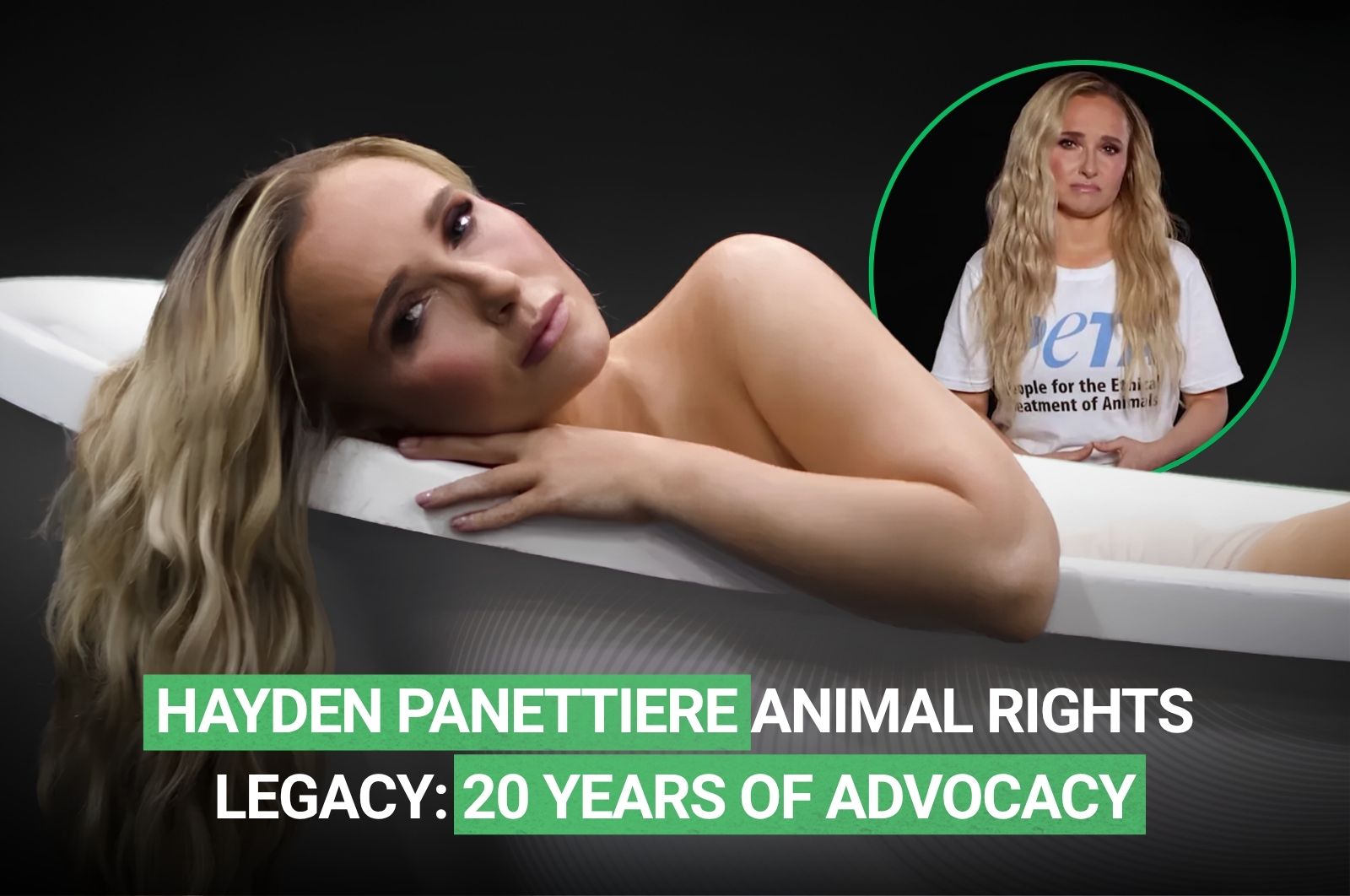
Hayden Panettiere died on August 16, 2026, in Greenville, South Carolina, at 36. Two days later, PETA released a video she had filmed with them roughly two weeks earlier. In it, she sits inside a bathtub, asks the viewer to imagine spending an entire lifetime confined to a space that small, and asks them not to buy tickets to marine parks that keep dolphins and orcas in captivity.
It was one of the last things she filmed. It was also, by any honest reading, the exact same fight she had been picking since she was 18 years old.
Below is what her animal advocacy actually looked like, moment by moment, over nearly half her life.
Taiji, 2007: the moment that made her an activist
In 2007, at 18 years old, Panettiere paddled a surfboard into the waters of Taiji, Japan, and physically tried to place herself between a pod of dolphins and the hunters who were driving them into a cove to be killed.
The footage of that moment was later folded into the Oscar-winning documentary The Cove), which brought the annual Taiji dolphin drive to a global audience for the first time. She was a teenage TV actress on the show Heroes at the time. She flew to Japan, went out into the water, and got pushed back to shore by the fishermen.
Local police issued an arrest warrant. She left the country before it could be served.
That one act, filmed at 18, sits at the origin of pretty much every serious celebrity intervention on marine mammal captivity that followed in the next decade. It is the moment the story starts.
Belugas, orcas, and a face-to-face with Putin
The Taiji trip made Panettiere a household name in animal-welfare circles, but the years that followed showed she was not a one-photo-op activist.
In 2013, the National Marine Fisheries Service denied a permit that would have allowed the Georgia Aquarium to import 18 beluga whales captured in Russian waters.
Panettiere publicly backed that denial and lobbied against the transfer.
She also met with Russian President Vladimir Putin as part of a broader effort to secure the release of nearly 100 orcas and beluga whales that had been captured for entertainment industry sale.
The animals were later released in what became known as the "whale jail" case.
These are not campaigns most fans would associate with her.
They did not make her Instagram grid. They made real, verifiable outcomes for animals.
Picture from Hayden Panettiere, Instagram
The final PETA campaign
The video PETA released on August 18 is short. Panettiere is inside a bathtub, clothed, filmed close. She looks directly at the camera and says:
"Imagine spending your entire life in a bathtub. That is what it is like for dolphins and whales in tiny tanks at marine amusement parks. We can end this, you and me."
The rest of the spot contrasts what dolphins and orcas do in the wild (dive to escape heat, feel rain on their backs, travel with their families) against what happens to them in a concrete tank.
She ends with: "Vow today to never go to a marine park that keeps dolphins in extreme captivity.
Together, we can end this cruelty."
It is a one-minute ad. It is also, at this point, a will.
PETA said in a statement that the campaign was always meant as a tribute to her work, not opportunism, and that the video had been in production before her death.
The organization asked supporters to honour her memory by refusing to buy tickets to any facility that keeps dolphins in captivity.
The full arc of her advocacy
Panettiere’s marine mammal work gets the most coverage, but her animal advocacy was broader than dolphins. A short list of what she took public positions on:
- Dolphin drive hunts in Taiji (2007 direct action, ongoing public pressure through the 2010s)
- Marine park captivity, specifically SeaWorld and similar facilities, from 2013 onwards
- Beluga whale import bans, backing the 2013 NMFS decision to block the Georgia Aquarium transfer
- Russian "whale jail" release through direct diplomatic engagement
- Fur-free fashion, joining multiple PETA campaigns over the years
- Anti-dolphin-slaughter legislation in the US and internationally, through petition and testimony work
This is not the shape of someone who signed onto a cause for a photoshoot.
This is a shape of someone who kept turning up for the same cause for eighteen years, across changing management, different production companies, and personal circumstances that would have made most people quietly stop.
Why this tribute matters for anyone thinking about their own choices
The uncomfortable truth about celebrity animal advocacy is that most of it is soft. A vegan cookbook here, a PETA campaign there, a red carpet mention of animal cruelty in fashion.
Panettiere was not soft. She got in the water. She showed up to Russia. She kept doing it.
Her final ask, the one she made two weeks before she died, was small. Do not buy a ticket to a marine park. Do not underwrite the machinery that keeps a whale in a concrete tank for forty years.
Chelsea, a dolphin recently referenced in PETA’s coverage, spent more than four decades at Six Flags Discovery Kingdom before her death. That is the specific reality Panettiere was pointing at.
You do not need to be a celebrity to make that particular boycott real. You just need to skip the ticket.
Frequently asked questions
What was Hayden Panettiere’s final PETA campaign about?
It was a video and photo campaign against marine park captivity for dolphins and orcas, filmed roughly two weeks before her death and released on August 18, 2026.
Panettiere is shown inside a bathtub as a visual comparison to the size of tanks used at facilities like SeaWorld. Her ask: do not buy tickets to marine parks that keep these animals in extreme captivity.
What happened at Taiji in 2007?
Panettiere, then 18, paddled a surfboard into the waters of Taiji, Japan, and attempted to physically block hunters from driving a pod of dolphins into a cove where they would be killed.
She was pushed back to shore by the fishermen and Japanese police issued an arrest warrant. She left the country before it could be served.
The footage was later included in the Oscar-winning documentary The Cove). Was Hayden Panettiere vegan?
She was a lifelong animal rights advocate but did not identify publicly as vegan in the way some other celebrities have. Her advocacy work focused on marine mammal welfare, anti-fur campaigns, and captivity issues, rather than dietary evangelism.
The distinction matters: animal welfare advocacy does not require a vegan label to be real, and Panettiere’s two decades of direct action on marine mammals stands on its own.
How can you honour her legacy?
PETA’s specific ask, in the tribute they released alongside her final campaign, was straightforward: do not buy tickets to facilities that keep dolphins, orcas, or beluga whales in captivity.
That includes SeaWorld and comparable marine parks in the US, and equivalent facilities globally.
Beyond that, supporting seaside sanctuary projects (which relocate captive cetaceans to netted ocean cove environments) is the ongoing structural work that groups like PETA and the Whale Sanctuary Project are pursuing.
One more thought
The temptation with a tribute like this is to reach for something poetic.
Panettiere would probably have hated that. She was direct in her advocacy, unfussy in her framing, and consistent in her ask across almost twenty years.
The ask has not changed.
Do not buy the ticket. Do not fund the tank.
If her story has moved you to look further into where your own choices fit into the wider picture of how humans treat animals, our category on animal welfare covers the ongoing work, and our beginner’s guide to plant-based living is a starting point for anyone who wants to extend the same care from marine mammals to the ones on their plate.