A new scientific review argues public health has been selling the wrong reason to eat vegetables. Immediate, visible reasons work better, and the research on why is stronger than most people realise.
For decades, health campaigns have made the same pitch about eating more plants: do it, and you may live longer. That message is true. It is also, apparently, not particularly persuasive.
A new narrative review published in Recent Progress in Nutrition in June 2026 takes a different angle.
Its authors, David Goldman of the University of Helsinki and Dr. Matthew Nagra of the University of British Columbia, argue that the strongest reasons to eat plant-forward may be the ones we already care about most: how we look, how we smell, and how other people respond to us.
The picture that emerges is stranger and more specific than the usual "eat your vegetables" nudge.
Three Pathways, Not One
The review breaks attractiveness into three biological channels that diet actually reaches: facial appearance, body odour, and body composition.
Each responds on a different timescale. Each carries partly independent information about the person carrying it.
This matters because most nutrition messaging treats "healthy" as a single blurry outcome.
Goldman and Nagra argue the outcomes people care about are separate signals, and that plant-forward eating is one of the few interventions that quietly moves all three in the same direction.
The Skin Signal
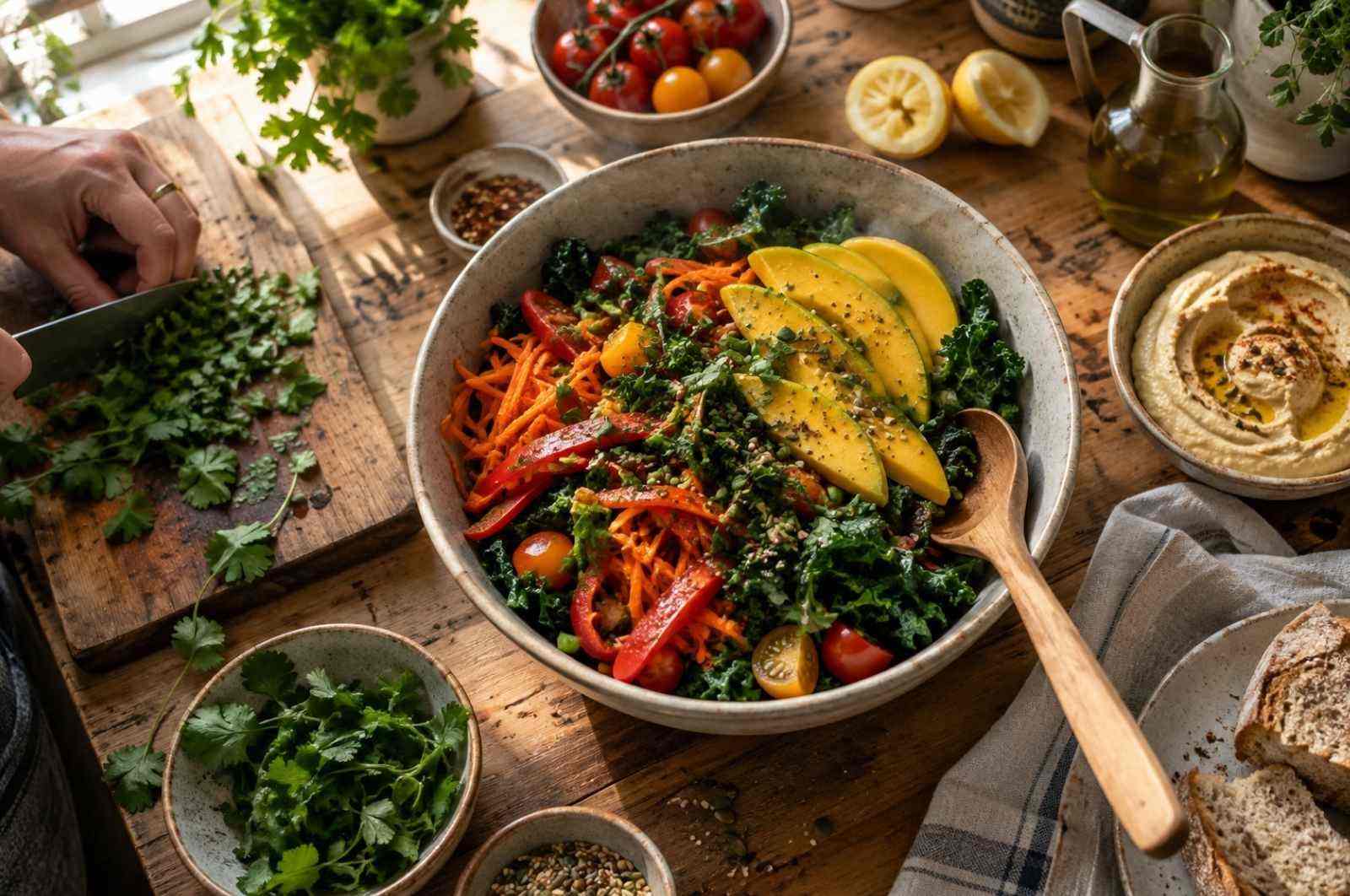
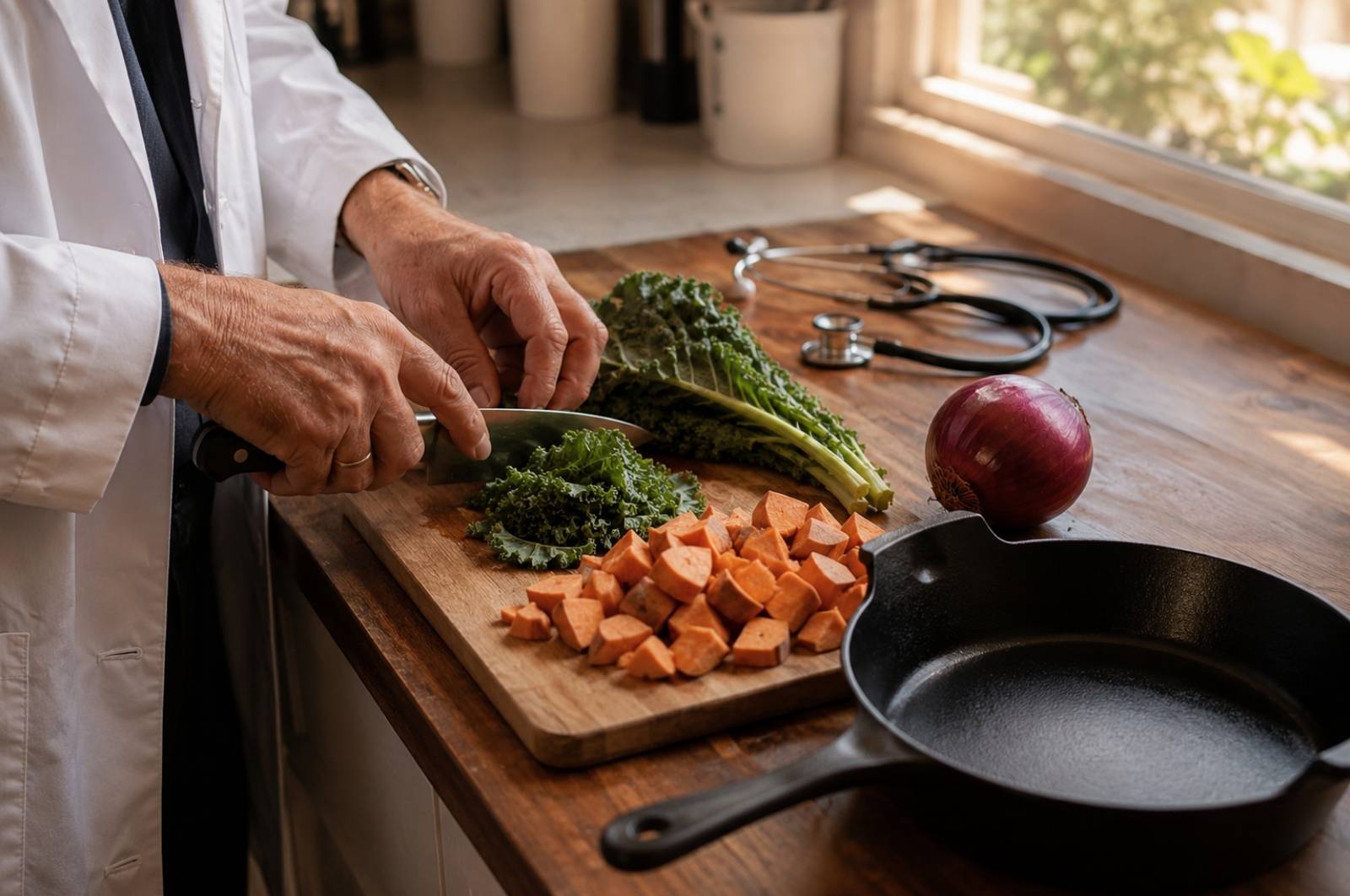
The clearest channel is skin colour. Carotenoids, the yellow, orange, and red pigments in foods like carrots, sweet potatoes, tomatoes, peppers, mangoes, and leafy greens, deposit in human skin.
The body cannot make them, so higher levels are a fairly honest sign of what a person has been eating.
In one longitudinal study cited in the review, tracking fruit and vegetable intake against skin measurements found that about 2.9 daily portions were enough to shift perceived health, and 3.3 portions enough to shift perceived attractiveness.
The timeframe is not decades. It is weeks.
A separate randomised trial in Malaysia gave 81 students a carotenoid-rich smoothie or plain water for six weeks. Spectrophotometric measurements picked up significant skin changes at the four-week mark in the smoothie group.
In observers rating faces, the effect ran through skin colour, then to perceived health, then to attractiveness.
Vegans, by way of comparison, have around 56 percent higher plasma carotenoid levels than omnivores, based on data from the Adventist Health Study-2.
The Odour Signal
The body odour findings are the ones most people find surprising.
A within-subject experiment led by Jan Havlicek at Charles University asked 17 men to eat a meat-rich diet or a non-meat diet for two weeks, then had 30 women rate their sweat samples.
The non-meat diet produced sweat rated as more attractive, more pleasant, and less intense. Perceived masculinity was unchanged.
A separate observational study found that men with more carotenoid-associated skin coloration also had sweat described as floral, fruity, and sweet.
Men whose diets skewed lower in vegetables were rated as more animal, meaty, and oily.
And then there is the finding almost nobody expects.
Garlic. Three within-subject experiments cited in the review tested raw garlic (6g and 12g) and garlic extract against a no-garlic control. At the 12g dose, garlic consumers were rated as having more attractive, more pleasant, less intense body odour.
The proposed mechanism runs through antioxidant capacity and the antibacterial effect on the axillary microbes that actually create odour.
Breath is a separate story: apples, lettuce, and spinach have been shown to reduce garlic breath through polyphenol oxidase activity.
The garlic finding rests on one paper of three linked experiments.
It has not yet been independently replicated. Worth knowing, worth not overstating.
The Body-Composition Signal
The third channel is the slowest and the most fraught. Body fat percentage sits inside a wider literature on what raters find attractive, and that literature carries real ethical baggage.
For male bodies, a 2025 cross-cultural study using DEXA-scanned images and raters in China, Lithuania, and the UK found peaked attractiveness ratings at roughly BMI 23 to 27 and body fat around 13 to 14 percent.
Plant-based diets have been linked in a 2025 systematic review to greater BMI and body fat reductions than omnivorous diets, though those studies did not measure attractiveness directly.
The connection here is inferential.
For female bodies, the picture is more complicated and, honestly, more troubling. Rater preferences in existing studies skew toward body fat levels below the physiologically healthy range.
Goldman and Nagra are explicit about this: an appearance-based campaign that targets weight for women risks reinforcing exactly the norms that harm people.
Why This Matters for the Way We Talk About Food
The single most useful line in the entire review is this one: framing attractiveness as a health incentive shifts the focus from distant, abstract disease risk to immediate, tangible indicators of vitality.
That is the pitch. And there is at least some evidence it works better than the standard message.
A 10-week randomised trial by Whitehead and colleagues gave 46 participants either a personalised visualisation of what their own face would look like with more fruit and vegetables, a generic visualisation, or a plain information handout.
Only the personalised group actually changed their diet, and the change held over 10 weeks.
Standard health information, on its own, did nothing measurable.
A separate survey of 802 people found 57 percent were motivated by even a simple demonstration of diet-related skin change. The motivation held across socioeconomic and ethnic groups.
This lines up with something anyone who has stayed with a plant-based diet for a while already suspects: the reasons that got someone started are rarely the reasons that keep them going.
What the Review Does Not Say
It does not say a vegan diet makes anyone objectively "more attractive." Attractiveness ratings are subjective, culturally shaped, and vary across observers.
It does not say carotenoid-induced skin colour is proof of better internal health. One 2017 study specifically found that beta-carotene supplementation raised skin yellowness and perceived health without measurably improving oxidative stress or immune markers.
The signal is real; the signal is not the underlying biology.
And it does not say every culture reads the same signals the same way. Chinese and Caucasian UK observers, in one 2018 study, showed opposite preferences on facial yellowness.
Any appearance-based nutrition messaging, the authors argue, needs to be culturally validated before it goes out at scale.
Goldman and Nagra also disclose consulting work with the Soy Nutrition Institute Global and, in Nagra's case, past affiliate partnerships with a couple of plant-based brands.
That does not invalidate the paper, which is a peer-reviewed literature synthesis. It is worth naming.
The Practical Takeaway
For anyone eating plant-forward already, the review is quiet validation of something you may have already noticed in yourself or in the people around you.
For anyone considering it, the useful reframe is the timeline: the noticeable changes do not require years.
Skin yellowness responds to fruit and vegetable intake in around four weeks. Body odour responds to dietary composition within two.
The old-you-versus-new-you gap is a lot shorter than public health messaging usually implies.
And carotenoids are cheap. Carrots, sweet potatoes, tomatoes, peppers, mangoes, papaya, spinach, and kale are among the highest sources per dollar. This is not a diet that requires supplements, apps, or subscriptions to work.
If you want to explore how the same plant-based pattern shows up in other outcomes worth caring about, our earlier deep-read on the 20-year study of 65,000 women and heart disease covers what the same eating pattern does inside the body. For a more practical start, the free 7-day vegan meal plan is built around exactly the kinds of carotenoid-rich foods this review flags as most useful. Our Take
The paper is not perfect. It is a narrative review, which means the authors chose which studies to include. The sample sizes in some of the underlying research (17 sweat donors, 15 male body images) are small.
The behaviour-change trial rests on 46 completers.
But the direction is consistent, and the mechanism is honest: eating more vegetables changes the visible and measurable parts of a person on a timescale short enough for that person to notice.
We have been telling people to eat plants for their arteries. It might turn out that telling them to eat plants for the person across the table was always going to land better.
We are not sure that is the whole answer, but we would rather see people make the change than argue about the reason.
If you are curious what the transition looks like day to day, our free 7-day vegan meal plan is a gentle way to test the water for yourself. No pressure. Just the plate.