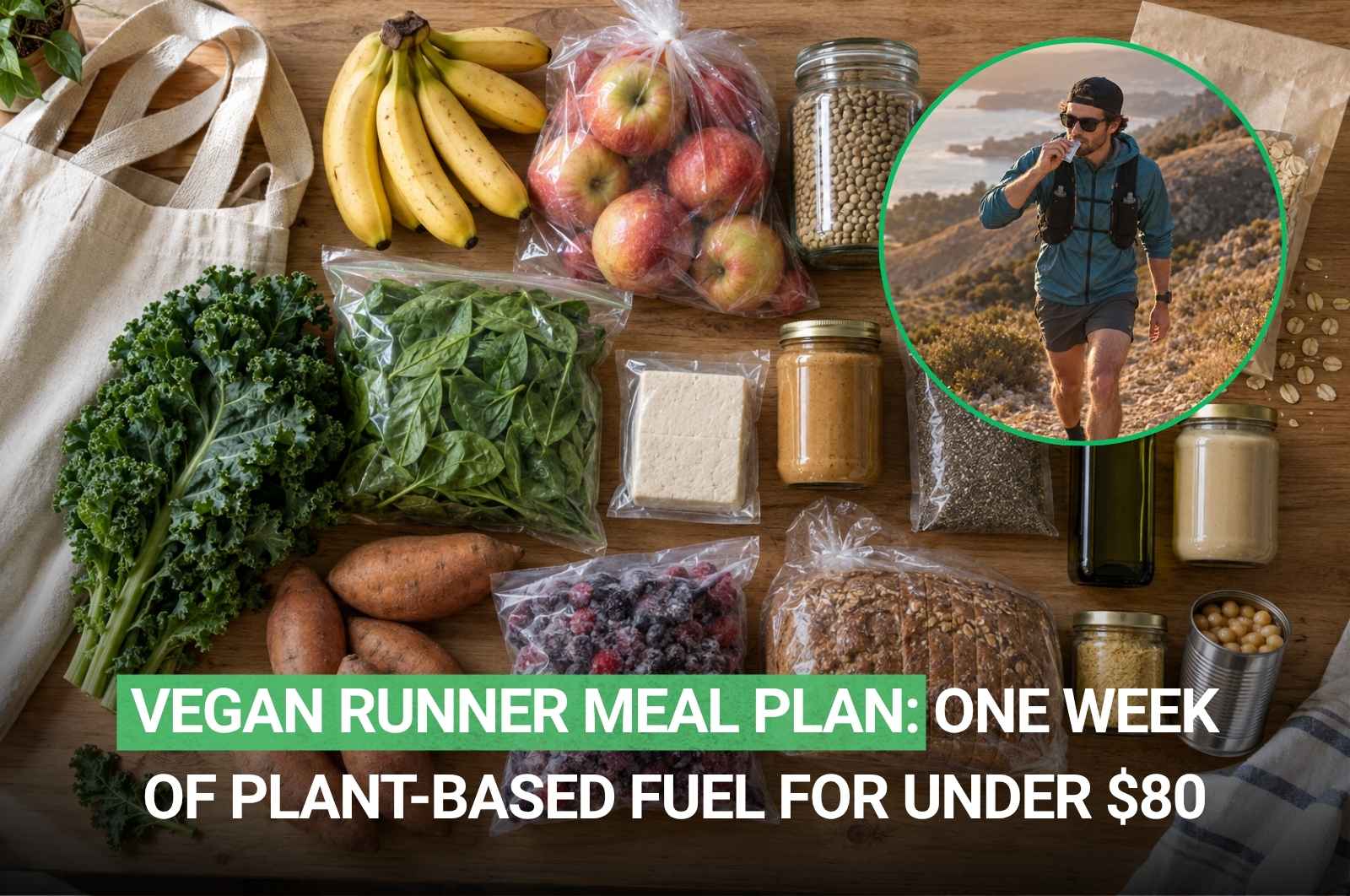
A registered sports dietitian's plant-based guidance is easier to shop for than most people think. We built a full week around it, priced every ingredient, and totaled the receipt.
The most common objection to plant-based eating for anyone training seriously is not health. It is cost.
The default assumption, especially in the US, is that eating well on a plant-based diet requires a Whole Foods membership card and a Vitamix.
It does not.
And the actual shape of what a registered sports dietitian recommends for a recreational endurance runner is, if you look at it carefully, made of some of the cheapest food in any grocery store.
We built a full week around it.
Priced every ingredient.
And the total, at a mid-sized US chain, was $76.14 for a single person's seven days of fuel.
Here is the whole thing.
The Framework
The plan is built around published guidance from Kelsey Costa, MS, RDN, a registered dietitian and volunteer running-group coach whose plant-based-for-runners recommendations have anchored coverage on this topic across multiple outlets, including our own piece on plant-based endurance training. Costa was not directly consulted for this specific meal plan. Her published guidance was.
The pattern she recommends for a recreational runner logging 20 to 35 miles per week looks like this:
- Whole-food carbohydrate as the fuel base: oats, brown rice, sweet potatoes, whole-grain bread, quinoa
- Legume protein at most meals: lentils, chickpeas, black beans, tofu, edamame
- Leafy greens most days for iron, folate, and nitrates
- Nuts, seeds, and tahini for calorie density and healthy fats
- Fruit as easy carbohydrate around training
- A B12 supplement, non-negotiable
Nothing on that list is exotic. Nothing on it costs more than $4 per unit at a normal grocery chain. The trick is not the ingredient list.
It is the assembly.
The Shopping List and What It Costs
Anchor Ingredients (one-time purchase, uses across the week)
- Rolled oats, large bag: $3.99
- Dried brown lentils, 1 lb: $1.79
- Dried black beans, 1 lb: $1.99
- Quinoa, 1 lb: $4.49
- Whole-grain bread, one loaf: $3.29
- Firm tofu, one block: $2.49
- Natural peanut butter, one jar: $4.99
- Tahini, one small jar: $5.99
- Chia seeds, small bag: $4.49
- Nutritional yeast, small container: $3.99
- Extra-virgin olive oil, small bottle: $5.99
Fresh Produce (weekly)
- Sweet potatoes, 3 medium: $3.29
- Bananas, one bunch: $1.89
- Apples, 4 medium: $3.99
- Kale, one bunch: $2.49
- Spinach, one bag: $3.29
- Broccoli, one head: $1.99
- Carrots, 1 lb bag: $1.29
- Yellow onion, 2 medium: $1.49
- Garlic, one head: $0.79
- Lemon, 2: $1.49
Pantry Reinforcements
- Canned chickpeas, 2 cans: $1.98
- Canned crushed tomatoes, 1 can: $1.79
- Vegetable broth, 1 carton: $2.49
- Frozen mixed berries, one bag: $4.99
Running total: $76.14.
The Week, Mapped Out
Breakfast, Every Day
Oatmeal with peanut butter, banana, chia seeds, and frozen berries.
This is the anchor. It hits about 550 calories, 18 grams of protein, and 12 grams of fiber, and it goes together in six minutes. Repeat every morning.
Runners who like variety can swap the peanut butter for tahini three days a week and the banana for apple slices. The base does not change.
Lunch, Rotation
Chickpea salad wrap on whole-grain bread.
Mashed chickpeas with tahini, lemon juice, salt, pepper, scallions, and celery, spread onto bread with a bed of spinach. Three of the seven days.
Big quinoa bowl. Cooked quinoa, black beans, roasted sweet potato cubes, a fistful of kale wilted in olive oil, a tahini-lemon dressing. Four of the seven days.
Dinner, Rotation
Lentil bolognese over brown rice or pasta twice in the week. Onion, garlic, canned crushed tomato, brown lentils, olive oil, herbs. Batch-cook Sunday, eat Sunday and Wednesday.
Crispy tofu, broccoli, and rice twice. Pan-fried tofu cubes tossed with soy sauce, garlic, and a splash of maple, alongside steamed broccoli and brown rice.
Black bean chili twice. Onion, garlic, beans, tomato, cumin, vegetable broth, wilted spinach folded in at the end. Batch-cook Wednesday.
One easier night, saved for the long-run day, when sandwich, apple, and a bowl of oatmeal is the meal. Runners know why.
Snacks and Around-Training Fuel
- Banana with peanut butter, before or after a run
- Apple with a spoonful of nut butter
- A slice of whole-grain toast with tahini and honey (skip honey for strict vegan)
- A small bowl of leftover chili as a mid-afternoon top-up
The Actual Point
The reason to write this out is not the meal plan itself. It is that the meal plan is boring.
No specialty products. No smoothie bowls with 14 toppings. No $17 per pound frozen entrees.
No powder that costs $45 a tub. Just oats and lentils and rice and vegetables, prepared in ways any adult can execute in under 30 minutes.
This is what almost every registered dietitian who works with recreational endurance athletes actually recommends, when they are not being asked to sell a product.
It is what the SWAP-MEAT Athlete trial at Stanford handed to its plant-based-diet arm. It is, roughly, what Torre Washington has been eating on his way to a Mr. Olympia stage.
And it costs a person about $76 a week.