
Swapping One Beef Dinner a Week for Beans Cuts More Carbon Than a Round-Trip Transatlantic Flight
The math on one weekly meal swap, using the largest food footprint dataset ever assembled, lands somewhere most people are not expecting.

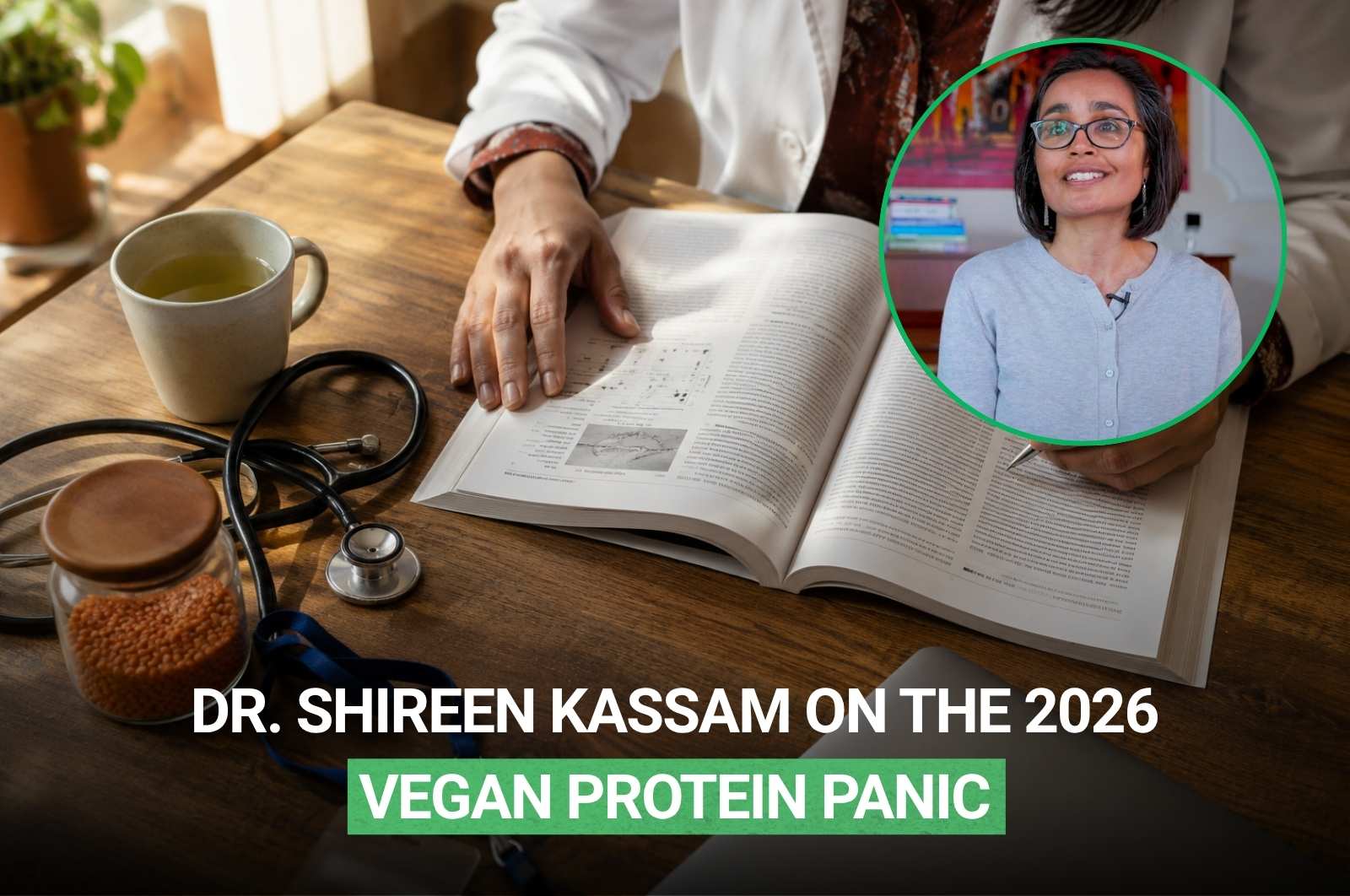
The 2026 protein panic against plant-based eating found a lot of oxygen on YouTube. The quietest, most credentialed pushback has been coming from a consultant haematologist at King’s College Hospital.
The 2026 protein panic did not start on TikTok. It landed there. It started in the small, well-funded ecosystem of low-carb podcasts, carnivore YouTubers, and the handful of clinicians who have built brands on the argument that plant-based eating is quietly failing the people who try it.
By late spring the argument had reached a familiar shape. Vegans, the pitch goes, do not get enough leucine. They do not eat enough total protein.
They lose muscle mass as they age. The science, we are told, is settling against them.
The person who has spent 2026 pushing back on that story, without a podcast studio and without a supplement line to sell, is Dr. Shireen Kassam.
She is a consultant haematologist and honorary senior lecturer at King’s College Hospital in London. She founded Plant-Based Health Professionals UK in 2018.
And her monthly evidence reviews, published on her Substack and the PBHP UK articles library, are one of the quietest and most consistently referenced sources of clinical pushback in the UK.
Kassam qualified as a doctor in 2000, completed a PhD on selenium and cancer chemotherapy sensitisation at the University of London, and has published peer-reviewed research in lymphoma and nutrition for the last two decades.
She sits on the Research Advisory Committee of the Vegan Society and is the Sustainability Lead for Pathology Practice at the Royal College of Pathologists.
None of that is a marketing bio. Every position is verifiable in the UK medical registers.
Her clinical work at King’s College Hospital, where she treats lymphoma patients, is not part of any advocacy business. It is her job.
That is the professional context for what she has been publishing this year.
Kassam’s August 2026 review, published on her Substack on 20 August, covered five research strands: plant-based diets and kidney health, ultra-processed plant-based patterns, nutrition alongside GLP-1 medications, healthy habits for brain and heart health, and the looming food-security question.
The kidney-health section pulled in a new UK Biobank analysis of 416,584 participants.
Vegetarians, including the small subset of vegans in the cohort (367 people), showed the lowest rates of chronic kidney disease when adjusted for the known risk factors.
The mechanism, as Kassam laid it out, is not exotic.
Plant-based patterns reduce the two biggest drivers of CKD, high blood pressure and type 2 diabetes, and they modulate the gut microbiome in ways that reduce systemic inflammation.
The ultra-processed section made the case that the same population-level data that supposedly damn plant-based eating actually damn ultra-processed food, and that the two are being deliberately conflated in the current wave of anti-vegan content.
This is not a rhetorical flourish. It is the same conclusion the Lancet-published French analysis landed on earlier in the year, which we covered in detail.
On GLP-1 and nutrition, Kassam’s position tracks the emerging clinical consensus we covered in our recent piece on Stanford’s Ozempic muscle-loss research: adequate protein intake and resistance training close most of the muscle-preservation gap without pharmacological help.
Kassam adds a specific point rarely made in the mainstream coverage. GLP-1 users skewing plant-based have the same protein-target problem as omnivorous users, but they also have the underlying dietary quality benefit that halves cardiovascular risk to begin with.
The two effects stack.
The clearest formulation Kassam has given of her position on plant protein came earlier this year in her PBHP UK protein guidance.
The document is short, unbranded, and clinical.
It states, in plain language, that a well-planned plant-based diet meets and typically exceeds the 0.8 g/kg body weight per day protein RDA for adults, and that active adults and older adults targeting the higher end (1.2 to 2.0 g/kg) can hit those targets on plants with modest attention to food selection.
Her position on the leucine question, which has become the anti-vegan community’s favourite talking point, is equally direct.
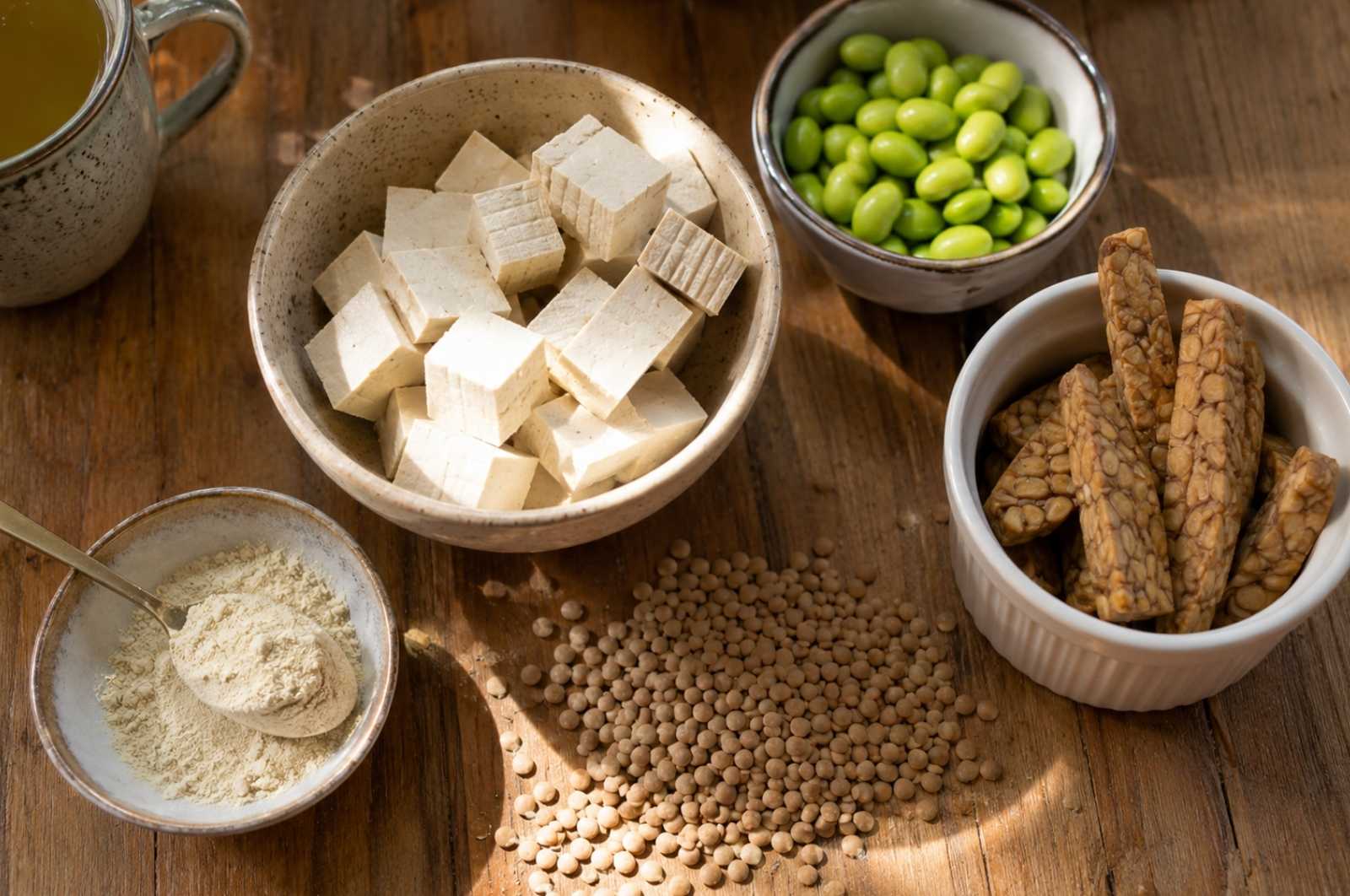
Soy, in particular tofu, tempeh, edamame, and soy milk, delivers leucine at levels comparable to animal protein sources. Pea protein isolate does the same.
The claim that plant-based diets are functionally leucine-deficient is, in her review of the evidence, not supported.
She is not the only clinician saying this. But she is one of the few saying it from a UK NHS consultant post, without a supplement stack to promote, and with a peer-reviewed publication record to back it.
Part of the reason the anti-vegan protein argument travelled so far in 2026 is that it slotted neatly into the GLP-1 conversation. Everyone on Wegovy and Mounjaro is suddenly worried about muscle loss.
he carnivore-adjacent voices arrived with a ready-made answer: eat more animal protein, ideally red meat, and lift heavy.
The plant-based community was slower to organise a response that landed.
Kassam’s response is that the answer is not the animal source. The answer is the dose, the frequency, and the resistance training. All three of those levers are available to a plant-based eater.
The reason plant-based eaters have historically lost the argument in the fitness space is not because the food failed. It is because plant-based eaters, on average, undereat total protein and underprioritise strength training.
Fix those two variables and the argument evaporates.
That is a less exciting position than either extreme.
It is also the one the evidence actually points at.
Kassam’s reviews are not really about plant protein.
They are about the fact that the UK NHS is buckling under the weight of cardiometabolic disease, and that plant-forward eating patterns are one of the very few interventions that have been shown, at scale, to reduce the incidence of the four biggest drivers of that cost: heart disease, type 2 diabetes, chronic kidney disease, and several common cancers.
In her 2022 argument that a national shift toward plant-predominant eating would save the NHS billions, she was working with pre-pandemic modelling data.
In her 2026 reviews she is working with post-pandemic data that is worse.
The chronic-disease trajectory in the UK, and in most high-income countries, has not improved. The interventions that would slow it are known.
They are, for the most part, not being deployed at scale.
That is the case underneath the case. When Kassam pushes back on the protein panic she is not defending veganism as an identity.
She is defending the largest and most consistent food-based public-health lever anyone has data on.
If you press her August review down to its blunt operational summary, it reduces to two words: eat plants.
Not “go vegan.” Not “all or nothing.” Not “buy a supplement stack.” Eat plants.
The rest of the review is the evidence for why, and the pushback against the arguments that say otherwise, and the practical guidance for the readers who want to do it well.
That is a message that does not travel well on YouTube.
It travels quietly, in Substack subscriber counts, in NHS clinics that have started referring patients to plant-based lifestyle courses, in medical schools running the University of Winchester plant-based nutrition module that Kassam developed. It travels in the kind of consistent, unflashy way that public health messaging has always travelled when it was actually working.
The 2026 protein panic will pass. Panics do.
What outlasts them is the boring, well-cited, consistent body of clinical evidence that Kassam and her peers keep publishing every month, without a supplement line, without a podcast crossover deal, and without the urge to make every review into a viral post.
When people ask us who to actually follow on plant-based nutrition, we point them at her PBHP UK publications library, at Neal Barnard’s PCRM output, and at Will Bulsiewicz’s clinical writing.
Not because those sources are the flashiest, but because they are the ones you can hand to a sceptical cardiologist or a suspicious relative without having to justify the source.
If you are eating this way already and getting the anti-vegan protein pitch from a friend, a colleague, or an algorithm, Kassam’s August 2026 review is the clearest single document you can send them.
Kassam’s monthly Substack review is free. Plant-Based Health Professionals UK publishes its articles library openly.
For readers new to the underlying evidence, our earlier coverage of the Lancet-published French analysis that split plant-based eating by processing level, and our piece on the 20-year women’s heart-disease study, are the two strongest pieces of the population-level case.
If you want to try it before you read the studies, our free 7-day vegan meal plan will get you the food in your kitchen.
Grocery list included!
No spam. Cancel anytime.