The Viral Advice to Wait 90 Minutes for Coffee Is Half Right. The Real Rule Is Different.
For roughly two years, one piece of caffeine advice has been repeated everywhere: wait 90 minutes after waking before your first cup.

Scientists have worked out how to read fear in a herd from orbit, and that single signal might do more to stop poaching than a decade of fences and patrols ever managed.

Here is the part that stopped me cold.
Researchers can now detect the exact moment a herd of zebra senses a threat, read that spike of collective panic through tracking tags, and use it to alert rangers before a poacher gets close.
The animals themselves become the alarm.
Not cameras. Not drones on a fixed schedule. The fear response of living creatures, beamed up to a satellite and back down to a phone in a ranger station.
It sounds like science fiction. It is closer to a working system than most people realise, and it is happening across reserves in Namibia and South Africa right now.
Every species has a tell. When danger shows up, a springbok does not react the way a giraffe does, and a giraffe does not react the way a wildebeest does.
At a private reserve called Okambara in Namibia, a research team spent days staging fake poaching raids. Drones filmed from above while GPS ear tags logged how each animal moved.
Some species bolted hundreds of metres in seconds. Others froze, stood tall, and swung their heads toward whatever felt wrong.
Those reactions turned out to be consistent.
Predictable enough that scientists started calling them behavioural fingerprints, distinct signatures you can teach a computer to recognise.
And that is the whole trick. If an algorithm learns what “zebras spooked by humans” looks like in the movement data, it can flag the pattern the instant it appears, day or night, in terrain no patrol could cover on foot.
Some of these trackers are the size of a grain of rice. They monitor GPS location, heart rate, body temperature, even the air pressure around the animal.
That last detail matters more than it sounds.
A racing heart and a sudden sprint together paint a far clearer picture than location alone. You are not just seeing where an animal went. You are reading how it felt getting there.
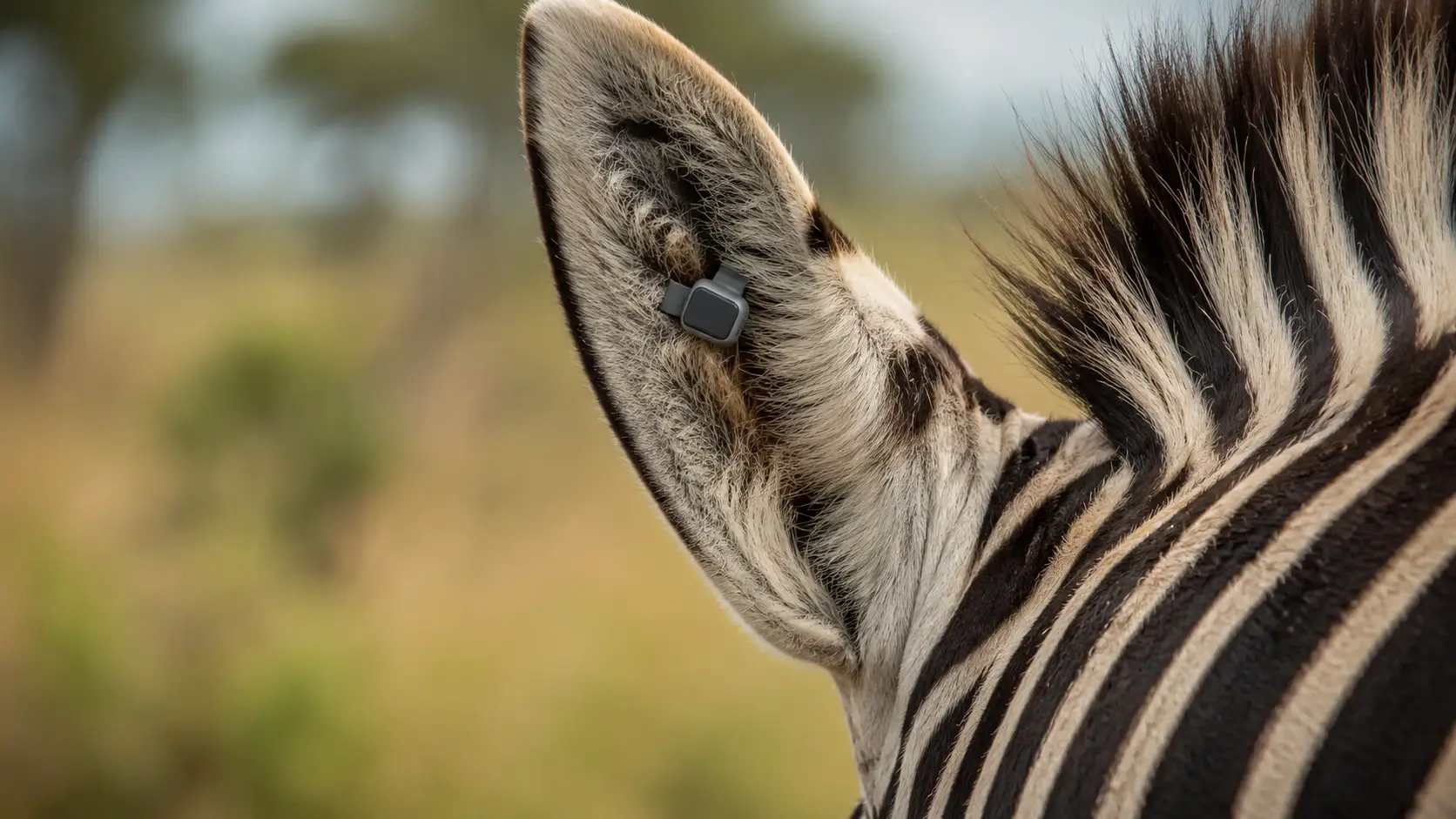
This panic-reading work feeds into something much bigger: a project called Icarus, led by Martin Wikelski at the Max Planck Institute of Animal Behavior in Germany.
Wikelski calls his vision the “Internet of Animals.” The idea is a constant stream of movement and health data from tagged wildlife anywhere on Earth, relayed through a network of small satellites and pooled into an open database called Movebank.
After a three-year pause, the first satellite of the new system launched in late November 2025. According to the Max Planck Society, a second receiver follows in 2026, with a full constellation of six satellites expected to be running by mid-2027.
Six satellites is the number that changes everything. That is what gets you near real-time coverage instead of a few passes a day, and near real-time is the difference between catching a poacher in the act and reading about a dead rhino afterward.
Wikelski has been blunt about the payoff. Speaking to reporters about the earlier version of the system, he said it helped save more than 10 to 15 percent of certain populations over recent years.
Reporting from National Geographic describes the same ambition from another angle: a system that could eventually predict disease outbreaks and even weather shifts by watching how animals move long before humans notice anything is wrong.
Animals have always sensed these things first. We are finally building the ears to listen.
It is easy to treat this as a cool gadget story. The stakes underneath it are anything but cool.
More than 10,000 rhinos have been poached in South Africa over the past 15 years, according to the International Rhino Foundation. That is not a slow decline. That is a slaughter with a deadline attached.
At Kruger National Park, tracking tags have already helped rangers free 80 wild dogs caught in snares. For a species with only around 400 individuals in that area, every single one of those rescues moves the needle on survival.
Here is the detail I keep coming back to. You do not need to tag the rhino to protect the rhino.
Because panic spreads. A tagged zebra reacting to an intruder can flag danger for an untagged rhino grazing nearby. The herd shares its fear, and the network reads it.
Every tagged animal quietly becomes a guardian for the ones around it. The ecosystem turns into one big sensor, and the species we are desperate to save get protected by the neighbours we already tagged.
I want to be careful here, because conservation tech has a long history of dazzling demos that fizzle in the field.
A few honest caveats:
None of that makes the breakthrough less real. It just means the satellites are a tool, not a miracle. The people on the ground still do the saving.
Drones, tags, and orbital data are part of a wider shift toward using technology to defend animals instead of exploit them, a thread that runs through a lot of the stories in our news coverage.
I started reading about this expecting another tech headline. I came away thinking about fear, and who gets to feel safe.
There is something quietly profound about science bending itself toward reading an animal’s panic, not to control it, but to honour it. To treat a zebra’s startle reflex as information worth protecting a whole landscape over.
That instinct, the one that says other creatures’ inner lives matter, is the same instinct that pulls a lot of us toward eating differently. It is the thread connecting a rescued snare-trapped wild dog to 200 chickens pulled off an Ohio highway.
Same impulse. Different scale.
If watching satellites learn to read animal fear stirs something in you, you do not need a tracking tag to act on it. You can start at your own table.
If you are even a little curious, our guide to starting a vegan lifestyle without feeling overwhelmed is a soft, no-pressure place to begin, and a handful of documentaries worth watching can do the rest of the convincing better than I can.
The animals are already sending the signal.
The least we can do is pay attention.
Grocery list included!
No spam. Cancel anytime.