The story of Hilda the sheep and the two-decade movement she quietly launched. On Farm Sanctuary's 40th anniversary year, the numbers behind one of the most consequential animal rescue organisations in American history.
Picture from Farm Sanctuary
In August of 1986, a 24-year-old activist named Gene Baur was documenting conditions at a stockyard in Lancaster, Pennsylvania when he walked past a pile of animals discarded on the ground behind the loading area.
Most were dead. One, a sheep, was still breathing.
Baur lifted her into the back of his vehicle, drove her to a veterinarian, and gave her a name: Hilda.
She lived for another decade. And the organisation Baur and his then-partner Lorri Houston founded to give her a home, Farm Sanctuary, would become the single most influential animal advocacy organisation in modern American history.
Forty years on, the organisation is celebrating its anniversary. The numbers behind those four decades are extraordinary.
The Numbers, In Order
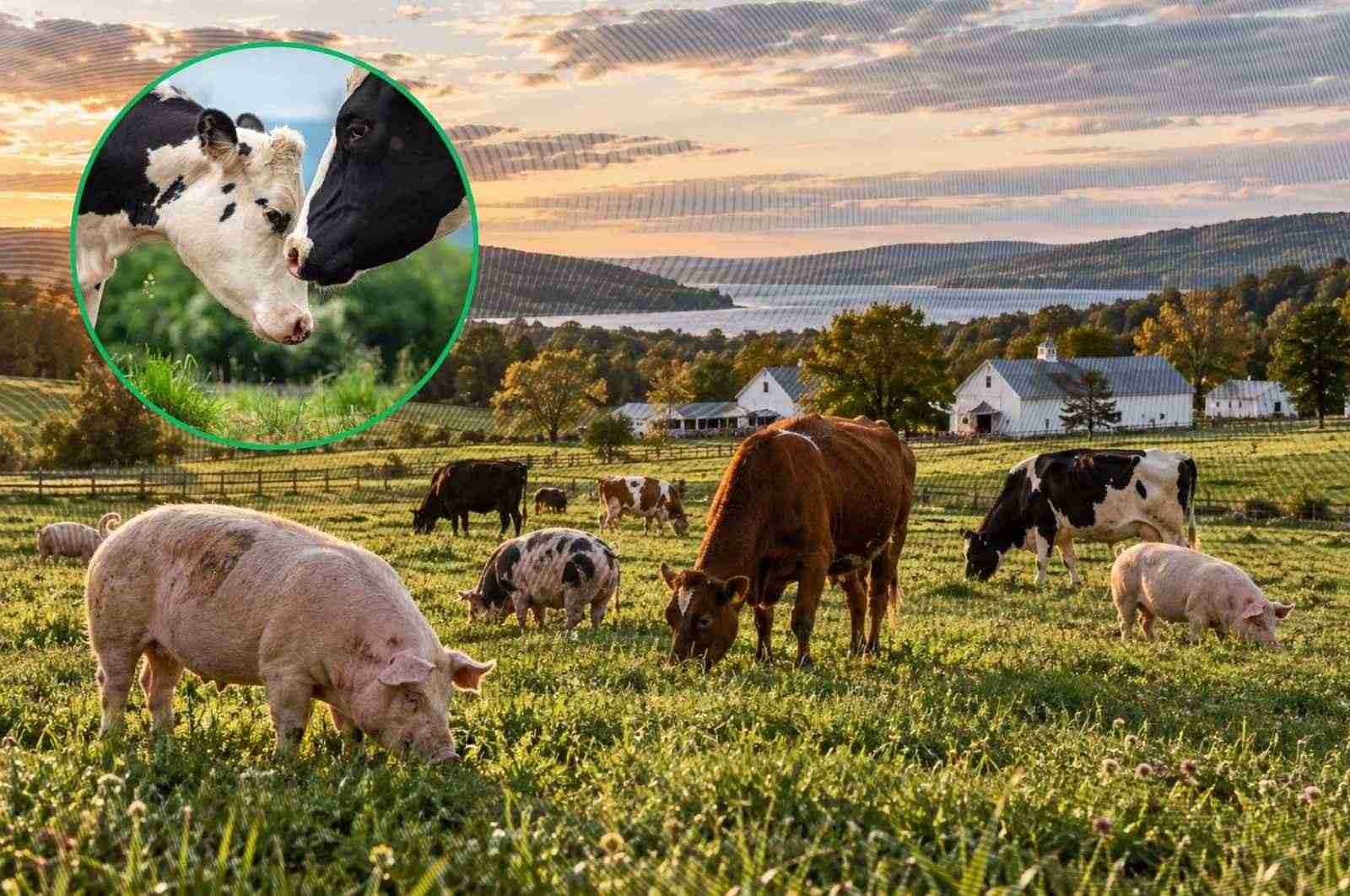
From that first rescue in 1986, Farm Sanctuary has grown into a two-shelter operation covering more than 300 acres, alongside a nationwide adoption network that has placed thousands of farm animals in loving homes over four decades.
- The New York shelter in Watkins Glen sits on 275 acres in the Finger Lakes region. It is home to more than 400 rescued farm animals: pigs, cows, sheep, goats, turkeys, chickens, ducks, and geese, most of them retrieved from cruelty cases, factory-farm escape situations, or the industry's standard practice of discarding animals that no longer produce.
- The Southern California shelter in Acton, roughly 45 minutes from Hollywood, spans 39 acres and houses approximately 100 rescued animals.
- The Farm Animal Adoption Network (FAAN), founded in 1986 in the same year as the sanctuary itself, connects urgent animal welfare needs to a national community of sanctuaries and adopters. It has helped thousands of abused, neglected, and unwanted farm animals find homes since its formation.
- The organisation's advocacy work has helped shape virtually every major farm animal welfare law passed in the United States in the past 20 years.
What Farm Sanctuary Actually Changed
The direct rescue work is what most people know Farm Sanctuary for. It is not, arguably, the largest part of the legacy.
The organisation was the first at scale to argue publicly that farm animals were individual beings with personalities, social lives, and emotional depth, not undifferentiated units of production.
In 1986, that framing was fringe. In 2026, it is mainstream enough to have driven ballot measures in eight states.
The path from Hilda in 1986 to Proposition 12 in 2018 was not a straight line.
But it was a line. The public narrative that made a 62 percent majority of Californians vote to ban gestation crates was built, piece by piece, on the kind of stories Farm Sanctuary had spent three decades telling.
Baur himself, a Cornell-trained sociologist, framed it plainly in a 2024 interview: "Farm Sanctuary is a place. But it is also a mission. The idea is to rescue individuals and then ultimately to change the world."
The Rescued Animals Whose Names You Know
Farm Sanctuary's residents have become recognisable enough in animal advocacy circles to have their own stories:
- Frank the steer, who escaped a New York slaughterhouse and, according to the sanctuary's account, was driven from the city to Watkins Glen in a "getaway car" by friends Jon and Tracey Stewart. He has been grazing in the pasture at the New York shelter for years.
- Liberty and Indigo, two cows who escaped a Pico Rivera, California slaughterhouse in 2021 in a mass break of 40 animals. Actor Joaquin Phoenix helped negotiate their release from the slaughter facility to Farm Sanctuary.
- Duncan the pig, a small piglet found in 2025 in a Michigan truck stop parking lot after apparently falling from a transport truck. He was placed through the Farm Animal Adoption Network into a permanent home.
- George the pig, once shy and unwell, now a regular on the sanctuary's social media, hanging out with what the staff describe as the most high-energy pig friends on the property.
The reason those names travel is that they turn the abstract question "should we treat farm animals differently?" into a concrete question, "should we treat this animal differently?"
The evidence over 40 years is that when the question is framed that way, most people say yes.
The Bigger Frame
Baur has often said the sanctuary sits close, geographically, to territory that was once part of the Underground Railroad in upstate New York.
"This tradition of liberating individuals from oppression and exploitation had been part of this area," he told an interviewer in 2024. "I felt pretty good knowing that."
It is the kind of framing that can sound heavy on paper. In person, in the pasture, it is what animal advocacy actually does at scale.
Farm Sanctuary's founding was contemporaneous with three other things that reshaped how Americans thought about food:
- The rise of factory farming as the dominant model for pork, poultry, dairy, and eggs.
- The publication in 1975 of philosopher Peter Singer's Animal Liberation, which had begun to reach a mainstream US audience by the mid-1980s.
- The steady, and initially very slow, rise of a US vegan movement that would eventually go mainstream in the 2010s.
Farm Sanctuary sat inside all three currents. It gave the ethical case a physical location.
What the 40th Anniversary Actually Looks Like
Farm Sanctuary is marking the year with a series of events at both shelters, a pre-order for a new book by Baur documenting the 40-year journey with unpublished images, and a broader public campaign around what the next four decades of the movement should look like.
The organisation has been transparent about the challenges facing farm animal advocacy at this specific moment: the rise of a well-funded political push to override state welfare laws (which we cover in our piece on the current Farm Bill's Section 12006), the collapse of Beyond Meat's stock price, and the corresponding narrative that the plant-based movement is stalling. Baur's response to that narrative has been characteristically direct: sanctuaries do not need consumer plant-based product sales to grow to sustain their mission.
What they need is people willing to fund the food, the veterinary care, the pasture maintenance, and the advocacy work that lets rescued animals live out their natural lifespans in peace.
The Individual Rescue Model, and What It Costs
One of the honest tensions inside animal advocacy is between rescue-focused work and systemic-change-focused work.
Rescuing an individual pig or cow costs money that could arguably fund policy campaigns saving more animals in aggregate.
Farm Sanctuary has been clear for 40 years that this trade-off is a false one: the individual rescues are what make the systemic work possible, because they give the abstract argument a face.
The organisation's 2024 financial reporting shows the operational side is not cheap.
Feeding and caring for hundreds of large-animal residents across two shelters, running the FAAN adoption network, and staffing the advocacy programme runs into the tens of millions of dollars per year.
It is fundraised, mostly in small donations, over and over.
Which is why the anniversary year matters as more than a milestone: sustained funding is how organisations like this outlast the political cycles that keep trying to defund the state laws they fought for.
Our Take
What we find worth naming, four decades on, is that Hilda was not exceptional. There were thousands of animals like her at stockyards across the country in 1986, and every one of them had the same claim on being alive.
What made her story different was that a single person stopped and picked her up.
That is not a scalable model of animal advocacy in a country that slaughters roughly 10 billion land animals per year. But it turns out to be a very scalable model of changing what people believe is possible.
Every ballot measure since 2002 that has expanded farm animal protections traces back, in narrative terms, to that kind of story.
For anyone whose response to the 40th anniversary is to want to help in a very immediate way, Farm Sanctuary runs a sponsorship programme for individual animals. And for anyone whose response is quieter, thinking about the pattern that fills their own plate, our free 7-day vegan meal plan is a low-pressure place to start. The animals at Watkins Glen are the ones who made it out.
The point of the last 40 years was to make more like them.