The UK regulator cleared the deal on 20 August. The math behind the price tag says more about the plant-based category’s next five years than any press release will.
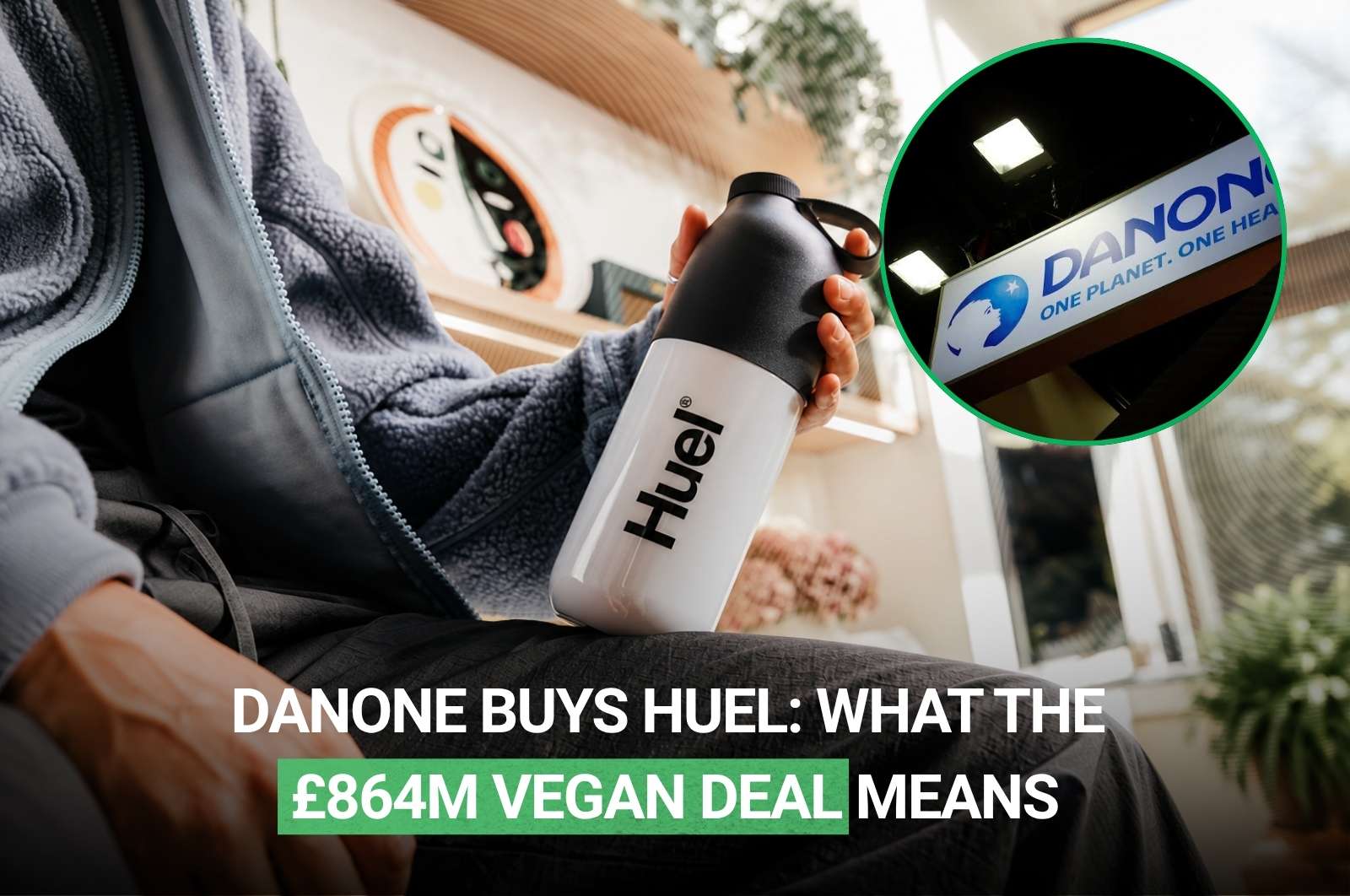
Picture from REUTERS/Sarah Meyssonnier and HuelThe UK’s Competition and Markets Authority cleared the deal on 20 August.
The transaction closes this month.
And with that, the loudest vegan-first consumer brand of the last decade quietly becomes a subsidiary of the company that owns Aptamil, Activia, and Evian.
This is not a hostile takeover. Huel’s founders wanted the exit.
Danone wanted the growth. Both companies are B Corps. Everyone has said the right things.
But the deal deserves closer reading than it has gotten, because the numbers behind it say something the press releases do not.
What Danone Actually Paid For
The reported price is £864 million, or roughly €1 billion.
Huel’s most recent filed accounts show £254 million in annual revenue and about £25 million in EBITDA.
That is a multiple of around 34 times earnings, which is the kind of number ordinarily reserved for scaling software companies, not powdered meals.
You do not pay 34x earnings for the powder. You pay it for what the powder unlocks.
Reporting from Danone’s own announcement and from analysts at FoodBev Media points to three things: a direct-to-consumer engine built on 600 million meals shipped, best-in-class digital marketing infrastructure, and permission to sell nutritionally complete food to healthy adults without a prescription.
That last one is the sleeper.
Danone already sells nutritionally complete formulas: Aptamil for babies, Nutricia’s Fortisip and Nutrison for hospital patients.
Those are regulated categories with fixed compositions and tight advertising rules. Huel sits outside all of that.
The Category the Press Release Will Not Name
Danone’s CEO called this an expansion into “Complete Nutrition.” That is the marketing language.
That number is climbing in the UK and Europe too. The single biggest clinical problem those users are running into is muscle loss during weight loss, with lean mass making up 25 to 40 percent of total weight lost on semaglutide.
The medical answer to that problem is spaced, high-quality protein and resistance training.
The consumer answer, for the millions of people who will not lift weights and will not track macros, is a shake with 40 grams of plant protein you can drink in ninety seconds.
Huel already makes that shake. Danone now owns it.
That is the deal. Everything else is context.
Why This Matters for the Plant-Based Category
For years the plant-based industry has been arguing with itself about whether “vegan” hurts sales at the shelf.
Huel has always been quietly, entirely, unapologetically vegan, and it has scaled to £254 million anyway.
What Huel proved is that when a plant-based product wins on convenience, price per meal, and nutritional density first, the ethics travel with it for free. Nobody buys a bag of Huel Black because it is vegan.
They buy it because it is £2.20 a meal, ready in ninety seconds, and hits 40 grams of protein. The vegan part is a bonus, not a hurdle.
Danone, which already owns Alpro and Silk, has seen that pattern before.
But it has never owned a plant-based brand with a subscription base and a direct-to-consumer margin structure.
That is the growth engine. And it is why the multiple is what it is.
What Actually Changes Now
Huel has told its customers that products, prices, and the leadership team stay the same.
On the subscription side, that is almost certainly true in the short term. Nobody spends £864 million to break the checkout flow.
The changes people will notice are further out. First: distribution. Huel is in 17,000 UK retail locations today.
Danone can push that number toward the 120 markets it already operates in, which is a scale Huel could not have built alone. Second: R&D.
Danone has more nutritional science bench depth than any independent plant-based brand can afford. Expect faster iteration on protein blends, gut-health additions, and functional ingredients.
Third, and this is where the friction sits: brand voice.
Huel’s marketing has always been sharp, sometimes irreverent, and occasionally in trouble with the Advertising Standards Authority over health and cost claims.
Danone’s marketing is corporate, compliance-heavy, and does not do irreverent. Something has to give there.
Historically the acquirer wins that argument.
The Awkward Part
Danone made €27.3 billion in sales in 2025. Its portfolio includes some of the largest dairy brands in the world.
Alpro, its plant-based arm, is a fraction of that.
The awkward part, said plainly, is that when a vegan-first brand sells to a company whose revenue overwhelmingly comes from milk and yoghurt, some of the ethical shine comes off.
Not because Danone is unethical.
It is a B Corp, which is not nothing.
But the founding proposition of Huel, that food should be built for the planet as much as the person, sits inside a company whose biggest business line depends on a herd of cows.
That tension is not going to resolve in a press release.
It resolves in what Danone does next: whether Huel keeps its manifesto voice, whether Alpro gets the same investment Huel now gets, and whether “Complete Nutrition” stays plant-based by default or drifts into whey.
If you run a plant-based CPG brand, the takeaway is straightforward.
The exit paths that opened up with Beyond Meat’s 2019 IPO closed hard when its share price collapsed.
This deal reopens them, but through a different door: acquisition by a Big Food buyer that has decided plant-based nutrition is the delivery vehicle for the next protein cycle, not the last one.
Danone’s CEO called this the start of “protein 2.0.” The first protein cycle was Beyond and Impossible trying to replace meat on the plate.
The second cycle is trying to replace the meal itself, for a customer who is already on Wegovy and does not want to think about lunch.
The plant-based brands that survive the next three years will be the ones that solve for that customer.
Our Take
The deal is good for Huel and good for Danone.
Whether it is good for veganism as a category depends on which brand ends up shaping the other.
If Huel keeps its manifesto and Danone learns from it, this is the moment plant-based nutrition stops being a niche and becomes the default answer to the biggest weight-loss cycle in modern medical history.
If Danone quietly softens Huel’s edges to fit the parent, then a great vegan brand becomes a great functional-nutrition brand, and the plant-based part of the story stops being the point.
We will be watching Alpro. That is the tell.
If You Are New Here
If this is the first piece you have read on plant-based nutrition, the shorter version is this: eating mostly plants is one of the most consistent health interventions we know of, and it does not require expensive shakes or subscription powders to get right.
A rotation of beans, whole grains, greens, tofu, and a few functional ingredients does most of the work.
Our free 7-day vegan meal plan is the least-effort way to try that for a week, and if you want to see what the research actually says, our coverage of the 20-year study of 65,000 women that found a 28 percent drop in heart disease on a mostly plant-based diet is a good place to start.