A new Stanford analysis quantifies the rebound. Meanwhile, the same body has a hormone system that responds to what is on the plate. Both stories matter.
The most quietly damaging line in the current conversation about weight loss drugs is the one people keep skipping past.
A 2026 analysis of more than 9,000 patients, reported by Stanford Medicine, found that people who stopped semaglutide or tirzepatide, the two most prescribed GLP-1, regained on average nearly two pounds every month after they came off the medication. That is not a scandal on its own.
Doctors have known for years that weight loss achieved by suppressing appetite tends to reverse when the suppression stops.
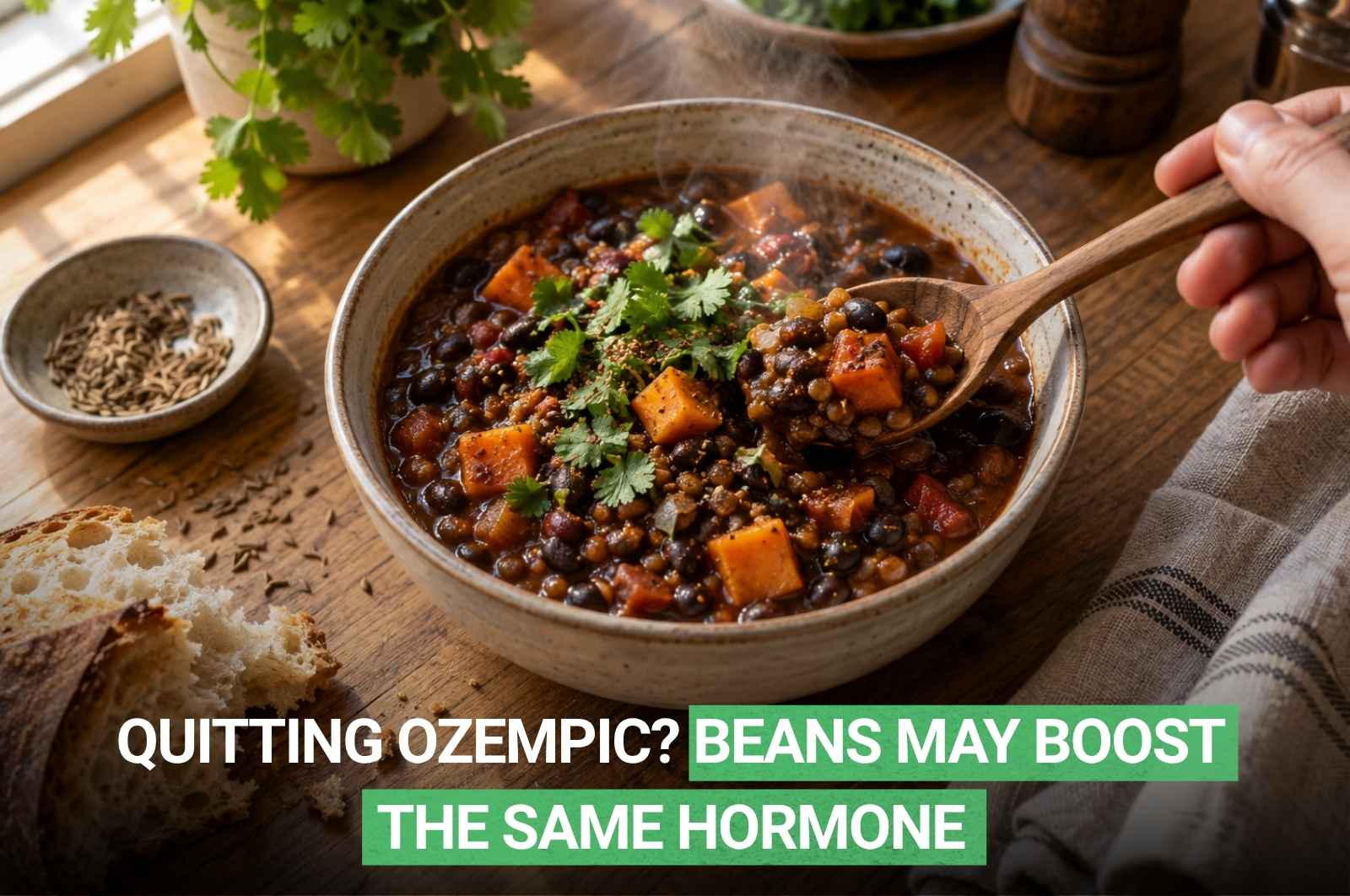
What is genuinely under-discussed is that the body already has a natural version of the same appetite-suppressing hormone the drugs mimic. And the strongest known dietary trigger for it is not chicken breast, cottage cheese, or an "Ozempic diet" bundle. It is beans, lentils, and whole grains.
What GLP-1 Actually Does
Glucagon-like peptide-1, GLP-1, is a hormone the gut secretes after a meal. It slows how quickly the stomach empties, tells the brain you are full, and helps the pancreas release insulin.
The drugs (semaglutide, marketed as Ozempic and Wegovy; tirzepatide, marketed as Mounjaro and Zepbound) work by mimicking that hormone at pharmacological doses well above what the body itself produces after any meal.
The result is powerful appetite suppression, dramatic short-term weight loss, and the by-now-familiar tradeoffs: nausea in roughly half of users, muscle loss that can account for up to 40 percent of total weight lost, and the regain problem when the drug stops.
The Stanford summary is unusually blunt: for most people, the lost weight comes back.
The Meal That Beats the Meat, Head to Head
Here is the study that should be much more widely known.
A controlled crossover trial fed the same participants two isocaloric meals on different days: one high in animal protein, the other plant-based, matched calorie for calorie. The researchers then measured gastrointestinal hormone responses in the blood.
The plant-based meal produced a larger GLP-1 response than the meaty one. Same calories. Different signal.
Dr. Michael Greger, walking through the evidence in his NutritionFacts.org series on Ozempic, points out that this is not one paper standing alone. The pattern shows up repeatedly in the incretin literature: plant-forward meals produce stronger post-meal GLP-1 curves than animal-based meals do. The magnitude is worth naming plainly.
A whole-food meal is not remotely as powerful an appetite suppressant as a weekly injection of semaglutide.
That is the whole point of the drug. But it moves the same hormone, in the same direction, and it keeps moving it every time you eat.
Why Beans, Specifically
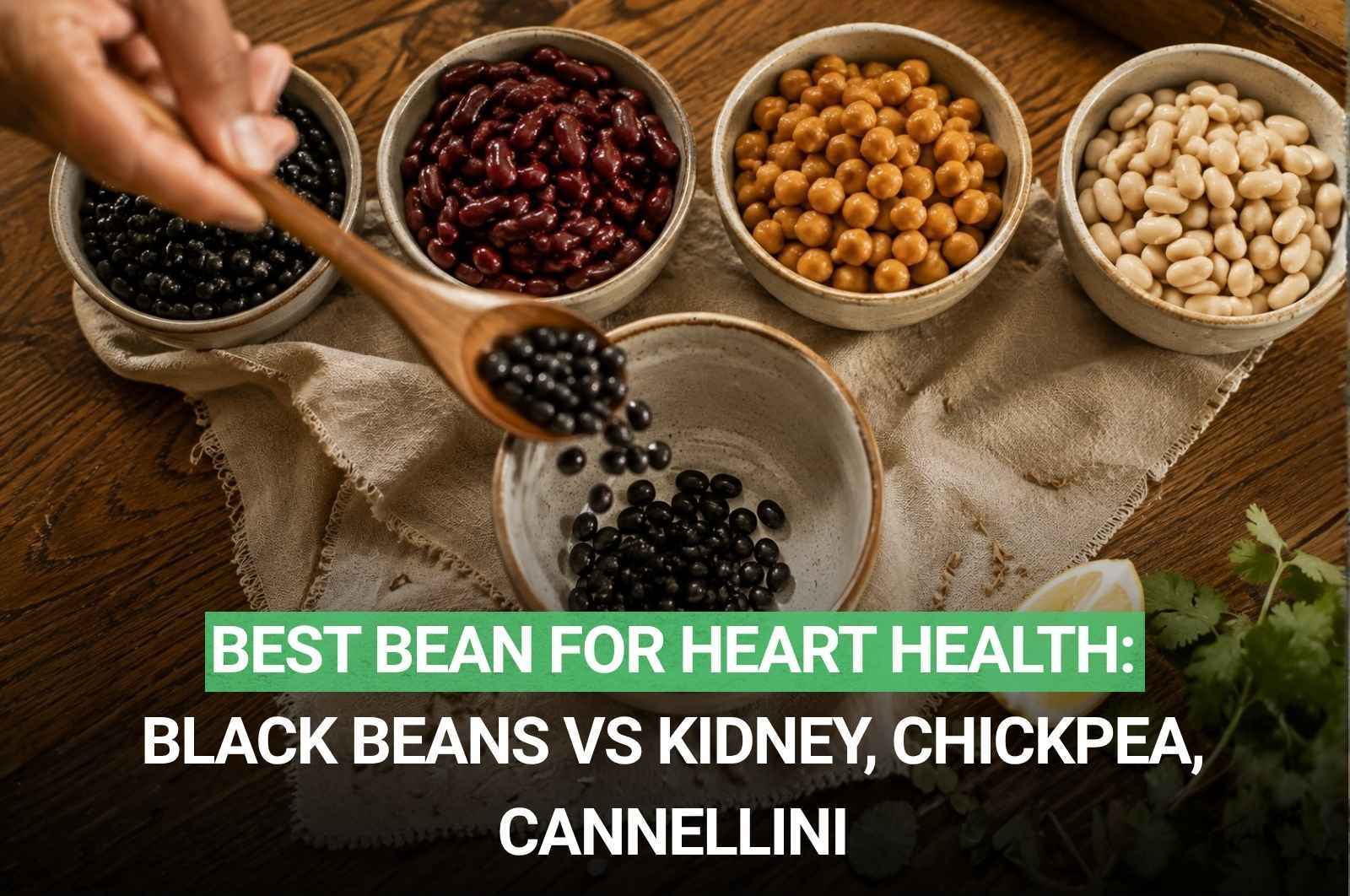
The GLP-1 signal from beans, lentils, and chickpeas is driven by two things: soluble fibre and slow-digesting protein.
Soluble fibre ferments in the colon, producing short-chain fatty acids that themselves stimulate GLP-1 secretion. Slow-digesting protein sustains the signal from the small intestine over hours rather than a fast, sharp spike.
What the "Foods to Eat on Ozempic" Guides Get Half Right
A 2026 dietary guide for GLP-1 patients advises prioritising 1.2 to 1.6 grams of protein per kilogram of body weight per day, and lists legumes as one of the most efficient foods to eat on the drug because they deliver both protein and fibre in the same forkful. The guide is technically correct. Its unstated logic is more interesting: the exact foods that maximise your outcomes on the drug are the same foods that maximise your natural GLP-1 response off the drug.
For patients coming off semaglutide or tirzepatide, that overlap is the entire opportunity.
Continuing the eating pattern learned on the medication (protein-first meals, fibre-rich vegetables, hydration, low ultra-processed food) is what preserves the gains. The Stanford summary is explicit that the strategies "are not temporary diet rules tied to the medication," they are sound nutritional principles that support long-term health.
A well-planned plant-based diet meets those principles almost by default.
The Muscle Question
One legitimate reservation about coming off a GLP-1 drug onto a plant-based pattern is the muscle-preservation issue.
On the drug itself, food intake drops so sharply that up to 40 percent of the weight lost can be lean mass.
Getting adequate protein at each meal is the standard clinical answer for preserving muscle both during and after treatment.
The claim that plant-based diets cannot deliver enough protein for this is now, in 2026, essentially dead.
For a person coming off semaglutide, the practical target is roughly 1.2 to 1.6 grams of protein per kilogram of body weight per day, distributed across three or four meals.
The Population Problem the Drugs Do Not Solve
The GLP-1 drug class is remarkable. It has genuinely changed obesity care for people who had run out of options. That is worth saying plainly.
It is also true that fewer than one in six Americans who could clinically qualify will ever be able to afford long-term access at current prices.
And a class of drug that has to be taken for life, at high cost, with an appetite-suppression profile that causes half of users to feel nauseous, is not a public health solution at the scale of the population.
A whole-food, plant-based dietary pattern is not a competitor to semaglutide.
It is an infrastructure, cheap and available, that either works alongside the drug or picks up the load when the drug stops.
And it does move the same hormone. Not with the same force. But every day. For free.
Our Take
We are not opposed to the GLP-1 drug class. For patients whose bodies have not responded to lifestyle change alone, they are a genuine breakthrough.
Anyone taking them for a legitimate clinical reason should keep taking them exactly as their doctor has prescribed.
What we would push back on is the framing that has crept into the wellness conversation: that these drugs make dietary change unnecessary. The Stanford data is the strongest recent evidence that they do not.
What people eat, on the drug and after it, still decides where the weight ends up in five years.
For anyone coming off a GLP-1 medication, anyone whose insurance changed, or anyone who never had access in the first place, the food pattern that maximises the body's own satiety hormone is not exotic.
It is beans, lentils, whole grains, and vegetables. Our free 7-day vegan meal plan is built around exactly that pattern, with a grocery list to make it easy to test for a week. The body's appetite system already works. The interesting question is what you are feeding it.