
The Viral Advice to Wait 90 Minutes for Coffee Is Half Right. The Real Rule Is Different.
For roughly two years, one piece of caffeine advice has been repeated everywhere: wait 90 minutes after waking before your first cup.

In 2018, Californians voted to ban gestation crates and battery cages by the widest margin in state history. A single clause in the current Farm Bill would erase that vote, and every one like it. The deadline is September 30.
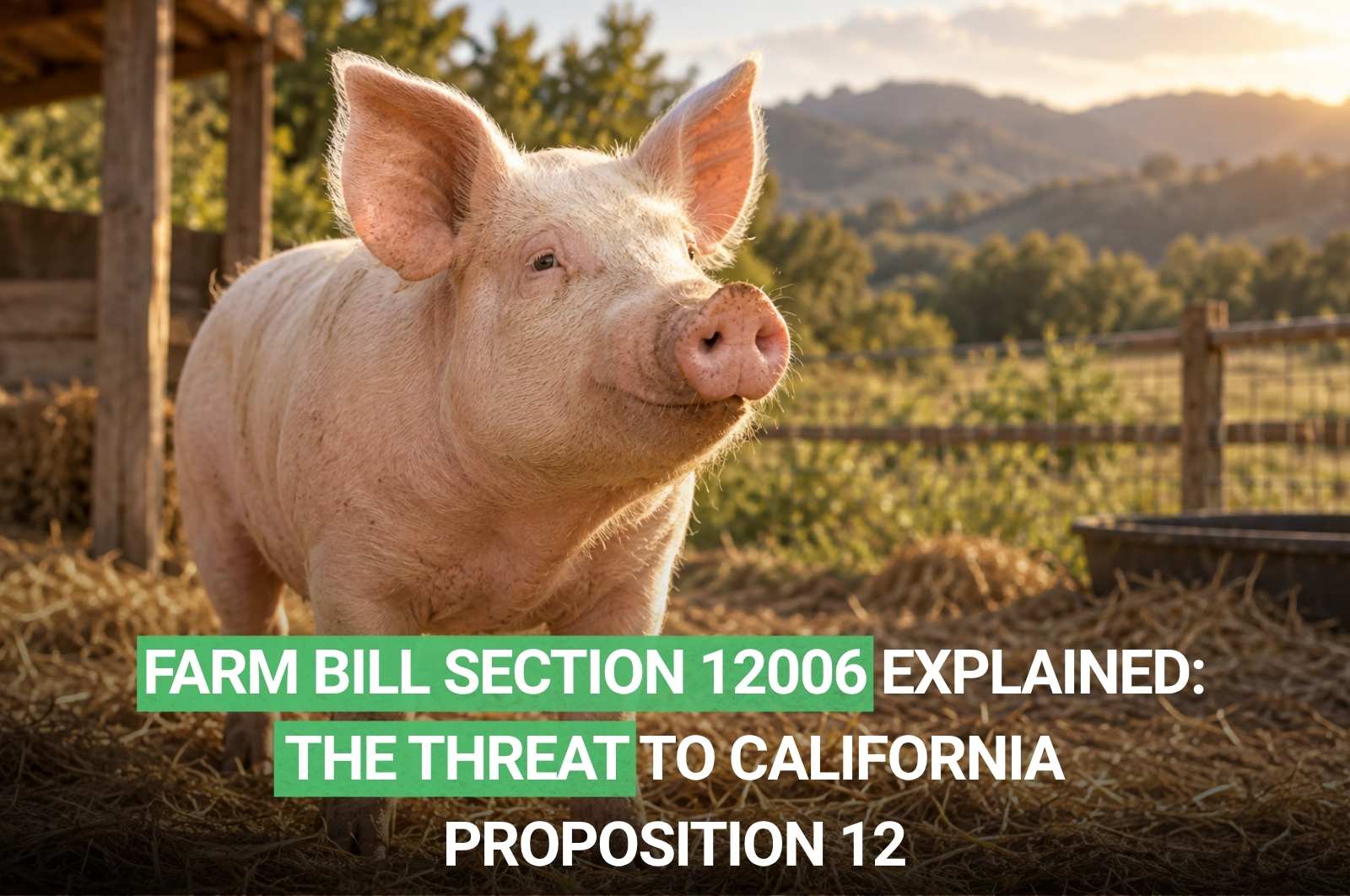
The 2026 Farm Bill is one of the largest pieces of legislation Congress considers, running to hundreds of billions of dollars and touching everything from crop insurance to school lunches.
Most of it is technical. A very small part of it, buried on page after page of appropriations language, is Section 12006.
That section, if passed as written in the House version, would invalidate California's Proposition 12 and Massachusetts' Question 3, the two most significant farm animal welfare laws passed by American voters in a generation.
And the deadline for Congress to pass a new Farm Bill or extend the current one is September 30, 2026.
To understand what is at stake, you have to understand what California voted for in November 2018.
Proposition 12 passed with 62.6 percent of the vote, the largest margin any farm animal welfare law has ever received in the United States. Voters approved a law requiring that:
Massachusetts passed a very similar law, Question 3, in 2016 with 78 percent of the vote.
Both laws also cover pork and eggs sold in those states, regardless of where the animals were raised.
That extraterritorial reach was the specific legal question the pork industry took to the Supreme Court in 2023, arguing it violated the interstate commerce clause.
The Court, in National Pork Producers Council v. Ross, ruled the law constitutional. The industry lost.
Which is why the fight has now moved from the courts to Congress.
Section 12006 of the House-passed Farm Bill is reported by The Humane League as identical to language from the earlier "Save Our Bacon" (SOB) Act and modelled on the failed "Ending Agricultural Trade Suppression" (EATS) Act.
The mechanism is straightforward.
The provision would prohibit any state or local government from imposing standards on the sale of agricultural products produced in another state.
That single sentence would nullify Prop 12 and Question 3, along with roughly a dozen other state laws covering the sale of eggs, pork, or veal produced under specific welfare conditions.
It would also, according to legal analysis by animal protection groups, potentially override state and local laws on food labelling, food safety, pesticide use, and packaging regulations.
The reason it is buried inside a must-pass bill is that must-pass legislation is the mechanism through which unpopular provisions typically move.
Any senator or representative asked to vote directly for overriding state welfare laws in isolation would face voter backlash.
Attached to a farm bill that also funds SNAP and crop insurance, the vote becomes structurally harder to isolate.
The immediate consequence is that pork produced in gestation crates in the Midwest could once again be sold freely in California and Massachusetts, the two states where voters explicitly banned it. Eggs from caged hens could return to the same shelves.
The longer consequence is more significant.
Prop 12 has been driving industry-wide reform far beyond California's borders.
Farms in states that have never voted on animal welfare laws have converted to group housing for sows and cage-free systems for hens because their largest customer state required it.
If Section 12006 passes, the economic driver behind that conversion disappears overnight.
The Humane Society estimates that the industry-wide shift toward cage-free egg production, currently at roughly 39 percent of the US flock, would slow or reverse.
Investment in group-housing infrastructure for pigs, which represents billions of dollars committed since 2018, would be stranded.
For hundreds of millions of individual animals per year, the consequence is being returned to confinement systems that voters have explicitly rejected at the ballot box in every state where they have been asked.
The current Farm Bill technically expired in September 2023.
Congress has passed a series of extensions since. The most recent extension runs through September 30, 2026.
That means one of three things will happen in the next few weeks:
The Senate has not yet advanced a companion provision to Section 12006. That is where the fight currently sits.
If the House and Senate reconcile a final bill and Section 12006 is inside it, Prop 12 and Question 3 are effectively dead.

The consistent story across every state that has voted on farm animal welfare is that voters approve these measures by wide margins.
Whatever the position of individual legislators in Washington, the population-level pattern is unambiguous.
When voters are asked directly whether pigs should be kept in crates too small to turn around in, they say no.
Section 12006 is a mechanism for overriding those votes without ever giving voters another one.
Advocacy groups tracking the legislation, including The Humane League, the Humane Society of the United States, and the ASPCA, have all published position papers opposing Section 12006 and pointing readers to their state senators and representatives.
The pork industry's trade body, the National Pork Producers Council, is the primary lobbying force pushing for the language.
The egg producers' trade body, United Egg Producers, has been quieter given how far the industry has already converted to cage-free housing.
A number of large food buyers, including several major fast-food chains that made public commitments to cage-free eggs and gestation-crate-free pork years ago, have not taken public positions on Section 12006.
Their silence has been noticed inside the industry.
The 200 chickens that survived the Ohio truck accident we covered earlier this year were the kind of animals that Section 12006 is designed to make invisible again.
This story does not read like other stories about plant-based eating. It is not about food on a plate. It is about whether a farm animal welfare vote taken by 62.6 percent of California's electorate in 2018 gets to stand.
We would encourage any reader who cares about the outcome to look up their two senators and their representative in the House, note their current position on Section 12006, and make one call.
The staff who log constituent calls do actually track them.
For anyone whose response to the news is that they no longer want to fund confinement farming at the grocery store either, the response is simpler than it looks.
Our free 7-day vegan meal plan is a low-pressure way to see what a week of eating outside that supply chain actually looks like. The vote in Washington is one lever.
What ends up in the cart is another.
Grocery list included!
No spam. Cancel anytime.